Departmental BFFs: Which UCSF departments publish the most often together?

Batman and Robin smoking

Some UCSF departments work more closely together than others. I looked at co-authorship patterns in papers published between January 2012 and November 2013, based on data in UCSF Profiles, and pulled out the UCSF departments that collaborate the most frequently. The results aren’t necessarily surprising. The Department of Medicine is huge, and their cross-departmental collaborations make up 8 of the top 10 collaborations, measured by volume. On the flip side, smaller groups with research areas similar to others make up many of the most common collaborations, by percentage; for example, one-third of papers by researchers primarily affiliated with the Proctor Foundation for Research in Opthalmology are co-authored with researchers from the Department of Opthalmology. I wouldn’t have necessarily guessed, however, connections like that between nursing and psychiatry.

Top UCSF cross-departmental collaborations, by volume

  1. Epidemiology & Biostatistics + Medicine: 365 collaborative papers
  2. Medicine + Pediatrics: 139 collaborative papers
  3. Medicine + Psychiatry: 127 collaborative papers
  4. Neurological Surgery + Neurology: 115 collaborative papers
  5. Medicine + Pathology: 105 collaborative papers
  6. Laboratory Medicine + Medicine: 104 collaborative papers
  7. Medicine + Surgery: 99 collaborative papers
  8. Neurology + Radiology and Biomedical Imaging: 92 collaborative papers
  9. Medicine + Radiology and Biomedical Imaging: 90 collaborative papers
  10. Medicine + Neurology: 86 collaborative papers

Top UCSF cross-departmental collaborations, by percentage

  1. 64.8% of School of Nursing Dean’s Office papers are co-authored with Physiological Nursing
  2. 36.8% of Proctor Foundation papers are co-authored with Ophthalmology
  3. 33.8% of School of Nursing Dean’s Office papers are co-authored with Medicine
  4. 33.3% of Physiological Nursing papers are co-authored with School of Nursing Dean’s Office
  5. 33.3% of Institute for Neurodegenerative Disease papers are co-authored with Neurology
  6. 32.4% of School of Nursing Dean’s Office papers are co-authored with Psychiatry
  7. 29.8% of Physical Therapy & Rehab Sciences papers are co-authored with Radiology and Biomedical Imaging
  8. 27.5% of Physiological Nursing papers are co-authored with Medicine
  9. 25.0% of Epidemiology & Biostatistics papers are co-authored with Medicine
  10. 22.8% of Family & Community Medicine papers are co-authored with Medicine

Details: Data is drawn from UCSF Profiles, and is based on a list of all publications listed on PubMed published between Jan 2012–Nov 2013, focusing on those whose authors include groups of researchers that have primary affiliations to more than one UCSF department. We counted only those publications from researchers with a listed department, and for the purposes of counting top cross-departmental collaborations by percentage, only those collaborations that generated 10 or more papers during the time period. No attempt was made to account for the widely varying sizes and scopes of different departments, the fact that researchers may have multiple departmental affiliations, or the fact that some publications may have been authored before the researchers were affiliated with their current primary departments at UCSF.

Photo: “Glasgow’s own superheroes having a smoke outside the Counting House” by Stephen Fyfe/Flickr, under CC-BY-NC-ND
UCSF’s top 20 most diverse internally-collaborative departments

When UCSF researchers collaborate between departments, how diverse are the collaborations? Here are the top 20 UCSF departments, ranked by the average numbers of UCSF departments their multi-departmental papers include as co-authors (from among the 39 departments whose researchers had a total of 25+ multi-departmental publications published between January 2012 and November 2013).

Details: Data is drawn from UCSF Profiles, and is based on a list of all publications listed on PubMed published between Jan 2012–Nov 2013 whose authors include groups of researchers with primary affiliations to more than one UCSF department. We counted only those publications from researchers with a listed department, and only those departments whose current associated researchers published 25+ publications in conjunction with current members of other UCSF departments between Jan 2012–Nov 2013. No attempt was made to account for the widely varying sizes and scopes of different departments, the fact that researchers may have multiple departmental affiliations, or the fact that some publications may have been authored before the researchers were affiliated with their current primary departments at UCSF. These are the top 20 departments, out of a total of 39 that match our criteria.

  1. Physiological Nursing: co-authors from avg. 2.57 other UCSF departments, among 116 multi-department papers
  2. School of Nursing Dean’s Office: co-authors from avg. 2.44 other UCSF departments, among 52 multi-department papers
  3. Anesthesia/Perioperative Care: co-authors from avg. 1.84 other UCSF departments, among 69 multi-department papers
  4. Physiology: co-authors from avg. 1.83 other UCSF departments, among 29 multi-department papers
  5. Family Health Care Nursing: co-authors from avg. 1.64 other UCSF departments, among 47 multi-department papers
  6. Laboratory Medicine: co-authors from avg. 1.63 other UCSF departments, among 104 multi-department papers
  7. Pharmaceutical Chemistry: co-authors from avg. 1.63 other UCSF departments, among 120 multi-department papers
  8. Pathology: co-authors from avg. 1.62 other UCSF departments, among 234 multi-department papers
  9. Radiation Oncology: co-authors from avg. 1.60 other UCSF departments, among 53 multi-department papers
  10. Microbiology and Immunology: co-authors from avg. 1.57 other UCSF departments, among 49 multi-department papers
  11. Cellular & Molecular Pharmacology: co-authors from avg. 1.57 other UCSF departments, among 74 multi-department papers
  12. Orofacial Sciences: co-authors from avg. 1.57 other UCSF departments, among 53 multi-department papers
  13. HDF Comprehensive Cancer Center: co-authors from avg. 1.55 other UCSF departments, among 31 multi-department papers
  14. Anatomy: co-authors from avg. 1.55 other UCSF departments, among 55 multi-department papers
  15. Pediatrics: co-authors from avg. 1.53 other UCSF departments, among 321 multi-department papers
  16. School of Nursing Community Health Systems: co-authors from avg. 1.52 other UCSF departments, among 31 multi-department papers
  17. Surgery: co-authors from avg. 1.50 other UCSF departments, among 227 multi-department papers
  18. Biochemistry & Biophysics: co-authors from avg. 1.49 other UCSF departments, among 75 multi-department papers
  19. Neurological Surgery: co-authors from avg. 1.47 other UCSF departments, among 393 multi-department papers
  20. Cardiovascular Research Institute: co-authors from avg. 1.45 other UCSF departments, among 53 multi-department papers

UCSF’s top 20 internally collaborative departments

Some UCSF departments consistently reach out out to collaborate with other members of the UCSF community. Here are the top 20 UCSF departments whose researchers have the highest proportion of publications co-authored with members of other UCSF departments from among departments whose researchers had a total of 100+ publications published between January 2012 and November 2013.

Details: Data is drawn from UCSF Profiles, and is based on a list of all publications listed on PubMed published between Jan 2012–Nov 2013 whose authors include groups of researchers with primary affiliations to more than one UCSF department. We counted only publications from researchers with a listed department, and departments with 100+ publications by current associated researchers between Jan 2012–Nov 2013. No attempt was made to account for the widely varying sizes and scopes of different departments, the fact that researchers may have multiple departmental affiliations, or the fact that some publications may have been authored before the researchers were affiliated with their current primary departments at UCSF. These are the top 20 departments, out of a total of 42 that match our criteria.

  1. Epidemiology & Biostatistics: 51.1%
    424 of 829 publications co-authored with other UCSF departments
  2. Proctor Foundation: 50.3%
    82 of 163 publications co-authored with other UCSF departments
  3. Pathology: 49.2%
    234 of 476 publications co-authored with other UCSF departments
  4. Physiological Nursing: 45.5%
    116 of 255 publications co-authored with other UCSF departments
  5. Neurological Surgery: 43.9%
    393 of 896 publications co-authored with other UCSF departments
  6. Orofacial Sciences: 42.7%
    53 of 124 publications co-authored with other UCSF departments
  7. Family Health Care Nursing: 37.0%
    47 of 127 publications co-authored with other UCSF departments
  8. Clinical Pharmacy: 36.9%
    58 of 157 publications co-authored with other UCSF departments
  9. Family & Community Medicine: 36.2%
    54 of 149 publications co-authored with other UCSF departments
  10. Radiology and Biomedical Imaging: 35.0%
    449 of 1284 publications co-authored with other UCSF departments
  11. Psychiatry: 33.5%
    252 of 753 publications co-authored with other UCSF departments
  12. Pharmaceutical Chemistry: 33.3%
    120 of 360 publications co-authored with other UCSF departments
  13. Pediatrics: 32.5%
    321 of 989 publications co-authored with other UCSF departments
  14. Anatomy: 31.8%
    55 of 173 publications co-authored with other UCSF departments
  15. Ob/Gyn & Reproductive Sciences: 30.7%
    185 of 602 publications co-authored with other UCSF departments
  16. Cell & Tissue Biology: 30.5%
    32 of 105 publications co-authored with other UCSF departments
  17. Dermatology: 30.1%
    129 of 429 publications co-authored with other UCSF departments
  18. Medicine: 27.7%
    1257 of 4545 publications co-authored with other UCSF departments
  19. Biochemistry & Biophysics: 26.8%
    75 of 280 publications co-authored with other UCSF departments
  20. Neurology: 26.8%
    400 of 1495 publications co-authored with other UCSF departments

HIV/AIDS research collaborations, visualized

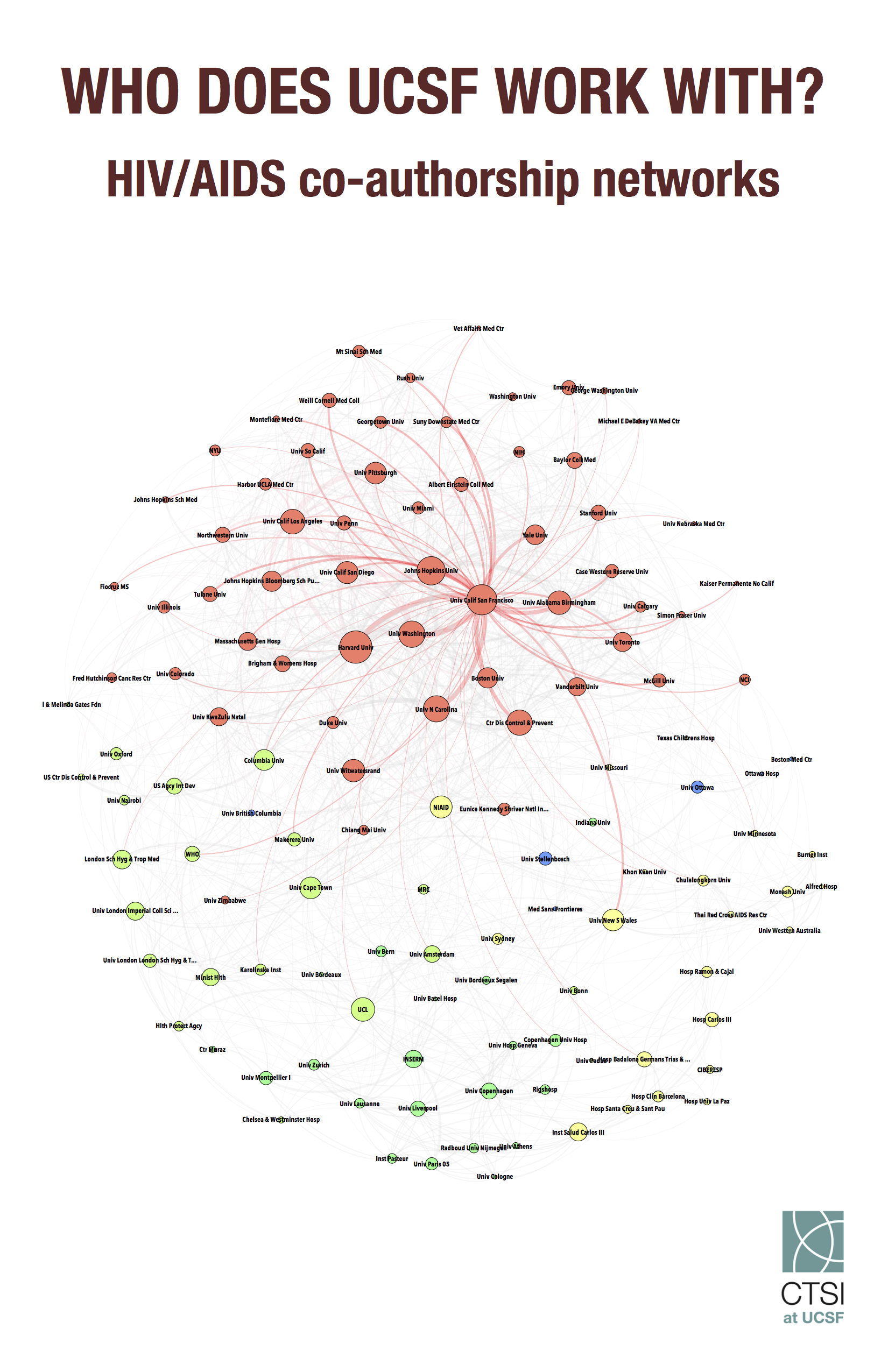
Co-authorship networks give us a sense of the strength of research collaborations. We used co-authorship data to visualize how top HIV/AIDS research institutions worked with one another, based on publications from June 2012 to September 2013. UCSF collaborations are indicated via red lines.

Visualization details: Data includes all known publications related to HIV/AIDS between June 2012 and September 2013 that includes co-authors from two or more institutions. We map each author to their institution, and the size of each institution corresponds with the number of HIV/AIDS publications its members co-authored in that time; only the most prolific institutions are shown to ensure readability of the image. The width of the lines connecting institutions corresponds to the number of publications that include co-authors from both of these institutions. Collaborations with UCSF researchers are indicated with red lines. Colors indicate clusters of institutions that often publish collaboratively, based on network modularity.

Click to view full-size image

HIV-AIDS Collaborations, June 2012 - Sep 2013

UCSF collaborations, visualized

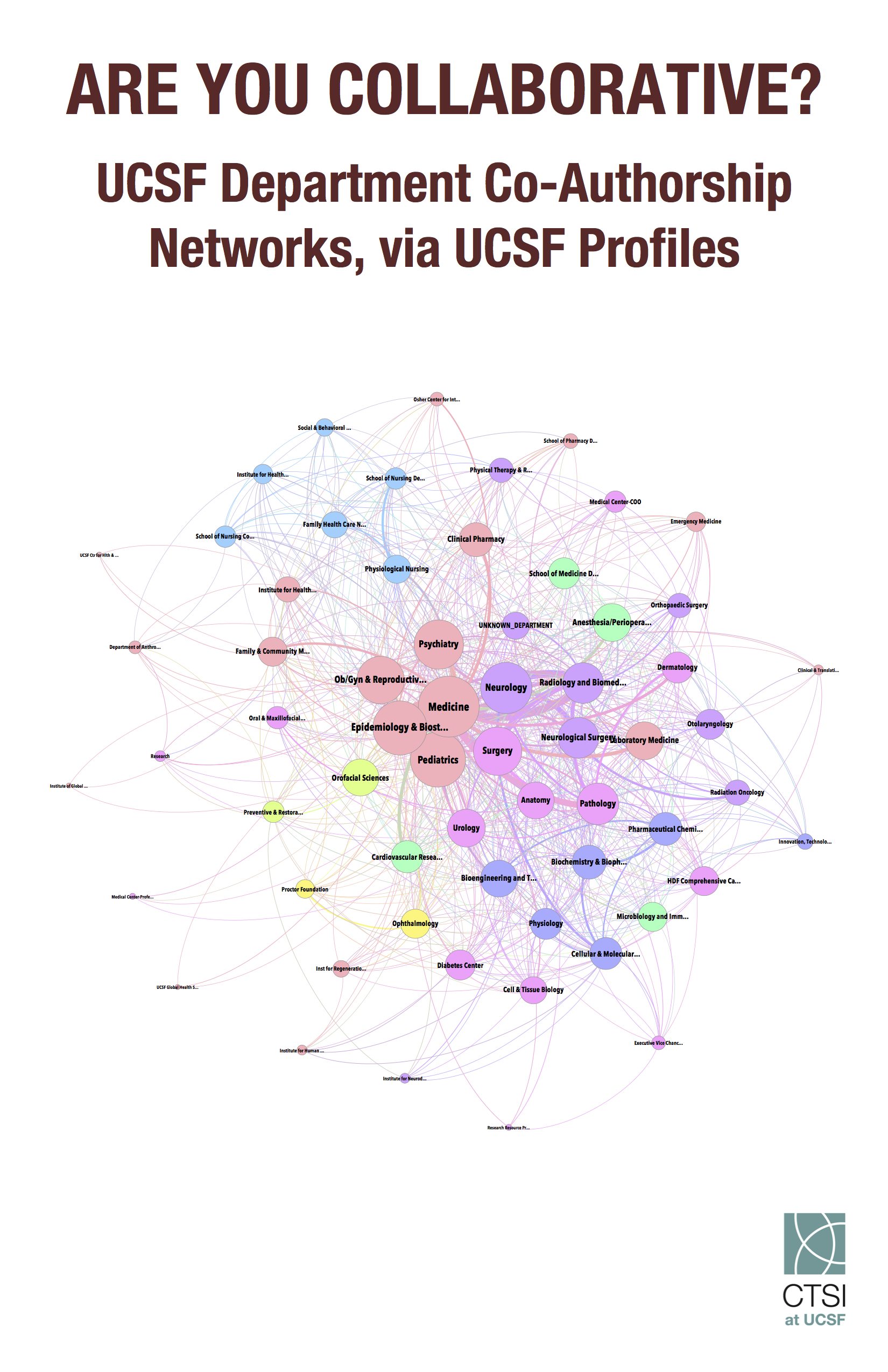
UCSF researchers often work closely with one another, across departments. We used data from UCSF Profiles to visualize how different departments work together, based on co-authorship patterns.

Visualization details: Data is drawn from UCSF Profiles, and includes all publications co-authored by current UCSF researchers from two more departments and listed on PubMed. The size of each department corresponds with the number of publications that members have published that include partnerships with other departments. The width of the lines connecting departments corresponds to the number of publications between two departments. Colors indicate clusters of departments that often publish collaboratively, based on network modularity. No scaling is done to account for varying sizes of different departments.

Click to view full-size image

UCSF internal collaborations, by department, based on publication co-authorship

ORNG at AMIA conference, in tweets

Eric Meeks from CTSI at UCSF presented on ORNG at the AMIA 2013 Joint Summits on Translational Science:

https://twitter.com/aasinaci/status/314852520327536640

https://twitter.com/Tideliar/status/314854263320883200

https://twitter.com/Tideliar/status/314854806219018240

https://twitter.com/Tideliar/status/314860793487310849

How Mailchimp uses network analysis

An example of Mailchimp mailing list clustering by readership overlap — “Fantasy sports! Guns! And flowers, for what I can only assume are apologies for doing something stupid with the first two.”

I sometimes forget what a powerful tool network analysis is. Mailchimp, a popular email newsletter provider, used several standard network analysis tools to look at subscribers to mailing lists using their platform, to calculate similarities between both subscribers and lists.

Read more:

Enhance your research networking platform, the UCSF way

Golden Gate Bridge

CTSI at UCSF has invested in increasing the usage and usability of UCSF Profiles, our research networking system. Based on our presentation at the 2012 IKFC meeting, here are our top 5 technical tips on how to increase the impact of your institution’s investment in research networking platforms, based on our past three years of work.

1. Measure

You can’t understand how you’re doing without measuring usage.

  • Install Google Analytics, then learn how to use this incredibly powerful tool (make sure to segment on-campus vs. off-campus traffic by setting up advanced segments based on service provider)
  • Register your site on Google Webmaster Tools to understand how search engines see your data

2. Optimize for search engines

UCSF Profiles gets over 50,000 visits a month. 72% of that traffic comes from search engines, primarily Google. Here’s how to increase traffic from search engines:

  • Implement a sitemap containing links to all your people profile pages, and make sure Google sees it using Google Webmaster Tools
  • Add a readable meta description (e.g. “Jane Doe’s profile, publications, research topics, and co-authors”) to your profile pages so they look better in search engine results
  • Add Schema.org data about your people on people profile pages
  • Advanced: use rel=canonical to prevent different versions of the same content from being indexed

3. Build inbound links

Linking is a critical way to both increase site traffic, and to signal importance to search engines.

  • Get websites large and small at your institution to link to your site (two years after launch, there are over 100 websites at UCSF that link to one or more pages on Profiles)
  • Encourage heavy linking to individual profile pages, e.g. from the campus directory, news articles, departmental profiles

4. Reuse data

Your research profiling system comes with APIs. Encouraging campus-wide reuse of this data can increase the impact of your investment. See opendata.profiles.ucsf.edu to see how UCSF is marketing this data.

  • Learn how to use your system’s APIs, so you can share that experience with others
  • Publicly document how the APIs work, and include sample source code
  • Reach out to campus technologists and webmasters to demonstrate how easy it is for them to reuse your data (e.g. the inclusion of Profiles data in UCSF’s mobile app was the result of technologist outreach)
  • Reach out to campus leaders to show them what kind of efficiencies they can gain by reusing your data (e.g. the inclusion of links to researcher profiles on the UCSF Directory was the result of a strategic partnership)

5. Extend with ORNG (advanced)

ORNG (OpenSocial Research Networking Gadgets) is a plugin system that allows you to add new apps into instances of Profiles or VIVO. Apps are written in HTML, CSS, and JavaScript, and are easy to share and reuse.

  • Install ORNG (OpenSocial) into your copy of Profiles or VIVO
  • Add new apps from the ORNG library of free apps
  • Write your own apps — most JavaScript programmers can get started in hours

Good luck! Feel free to leave comments and questions on this post—we’re happy to share what we know.

P.S. Thinking about how to make your campus equipment/services more discoverable? Try UCSF’s Plumage, the open source platform behind UCSF Cores Search.

Photo credit: digitonin via photopin cc

CTSI 2012 Retreat: The Live-Tweet

The 2012 CTSI Retreat was the first to be live-tweeted, under the #CTSI2012 hashtag. Fourteen people tweeted 144 original tweets. This year’s participants mostly repeated interesting points from speakers; perhaps we’ll see more original commentary or conversation in coming years, as familiarity with the medium increases.

Here’s a mildly-curated overview of the event, in tweets. (Consider browsing the whole thing—my favorite part was the very last panel.)

>> The event begins

Introduction by Clay Johnston

http://twitter.com/PRSatCTSI/statuses/228212804543467520

>> “Business Transformations” panel discussion

Panelists: Jonathan SchwartzVictoria Hale, in conversation with Clay Johnston

■ Panelist 1: Jonathan Swartz

http://twitter.com/PRSatCTSI/statuses/228225597430722560

■ Panelist 2: Victoria Hale

>> Leveraging the UC Network

Speaker: Rachael Sak, with Clay Johnston

>> Discussing ideas for new initiatives

Breakout sessions by Leslie Yuan. Discussion by June Lee, Sally Mead, Bill Balke, Mark Pletcher, Elizabeth Boyd, Ralph Gonzales, moderated by Kevin Grumbach

■ Breakout sessions, and voting for the top idea

http://twitter.com/PRSatCTSI/statuses/228248229081391105

■ Discussion of the top 3 ideas

>> Message from UCSF Chancellor Susan Desmond-Hellman

Message from Susan Desmond-Hellman, in conversation with Clay Johnston

>> Feedback from UCSF deans

David Vlahov, Sam HawgoodB. Joseph Guglielmo

>> “Disruptive Innovation in Translational Research” panel

Participants: Jeff Bluestone, Catherine Lucey, Deborah Grady, Mini Kahlon

>> Wrapping up…

Measuring federal social media interaction rates—and how UCSF fares

I love Expert Labs‘ new Federal Social Media Index, a unified dashboard of Twitter interaction stats for 125 different federal agencies. The effort itself is quite impressive, but the stats are even better.

Most agencies have a large number of followers, but a minuscule number of people actually responding to queries. If the point of social media is to be social, agencies are doing a fairly poor job.

How are UCSF Twitter accounts faring? I tried searching Twitter for replies to queries from several UCSF accounts from the morning of April 10 to the morning of April 14 (this excludes retweets and mentions).

The results?

  • @ucsf: 0 replies
  • @ctsiatucsf: 1 reply (a thank you from the UCSF library)
  • @gladstonelabs: 1 reply (a thank you from Bay Area Malaria)
  • @ucsf_library: 0 replies
  • @ucsfdentistry: 0 replies
  • @ucsfmedicine: 0 replies

For better or for worse, we’re doing about as well as the federal government.

Read more: