How Social Media Is Changing the Way We Talk About Science

Five Questions With UCSF Neuroscientist Bradley Voytek

Brad Voytek, PhD, a post-doctoral fellow at the University of California, San Francisco, makes use of big data, mapping, and mathematics to discover how brain regions work together and give rise to cognition. In his work as a researcher, science teacher, and outreach advocate, he regularly uses social media such as his blog Oscillatory ThoughtsTwitter, and Quora. In 2006, he split the Time magazine Person of the Year award.
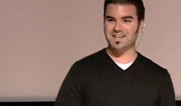
Bradley Voytek

Brad Voytek, PhD

Q: You’re interested in leveraging data to modernize science. Do you see a role for social media in changing research? 

Social media already is changing research. In many ways! First, there’s a direct effect wherein scientists are beginning to use data collected by social media organizations to analyze behavioral patterns, such as a study from 2011 that looked at millions of tweets to analyze fluctuations in mood.

The way we conduct and communicate research is also changing. Since the 1600s, scientists have communicated findings through peer review. But these results are static, and conversations regarding specific study details, methods, etc. were private. Now, scientific publishing organizations like Nature Network or SciVerse and professional sites such as Mendeley and ResearchGate are providing platforms for open communication and ongoing conversations about research projects.

Q: You’re using social media to promote your work. What motivates you to do that, and what do you see as the benefit?

While in a sense the first statement is correct, “promotion” is a loaded term. Science is an opaque process, and scientific publications are jargon-laden, dense documents that are inaccessible to all but the field-specific experts. These publications give an idealized view of the scientific process–from clear hypothesis to statistically significant result. The reality is a world messier and less certain than that, and I use my blog to communicate that.

Having students just jump in and read these artificially-refined and specialized manuscripts and Social media quote_Bradley Voytekexpecting them to learn from it is like trying to teach English by having someone read Shakespeare: it’s technically correct but the end result will be a mess.

I get a sense that many of my blog’s readers are undergraduate and graduate students, and I aim to communicate the real difficulties and uncertainties of science with them. I remember being there feeling confused, and feeling really dumb because I didn’t “get” scientific papers and could never imagine myself coming up with a novel idea, running an experiment to test it, and writing a paper. I remember looking at the CVs of really smart post-docs and professors and seeing page after page of amazing compliments and thinking I was inadequate.

My goal is to demystify the scientific process, to make it more real, to show how hard everything is, but also that it’s doable. I’ve got a whole section of my CV titled “Rejections & Failures” outlining every grant or award I was not given, every paper not published. I believe that listing those failures shows fledgling scientists that the process is hard, but not because it requires super-intelligence, but rather super-diligence.
Q: You recently made an offer on Twitter inviting people to ask you questions about neuroscience. Can you tell us about that?

This exemplifies another reason I blog, use Twitter, etc. When teaching, I took to heart the idea that if you can’t explain something clearly, then you truly have not internalized it and don’t really understand it.

Social media is a way for me to continue sharpening my understanding of difficult concepts. The time investment isn’t important to me–my job is to learn and discover, and this is another aspect of that. And if in the process I make something more clear and accessible to a possible future scientist, all the better. No scientist achieved their breakthroughs because they communicated less.

As for the offer on Twitter, I got quite a number of excellent questions, but a few stood out that really made me think. Specifically, there were three that are directly relevant to my research and that got me digging around the literature some more to figure out the answer. The questions essentially boiled down to two ideas: First, how plastic is a mature brain? And second, how many neurons can you lose before you (or someone else) notices?

Ultimately I wrote a blog post on what I’d found and rolled some of that writing and those ideas into peer-reviewed papers I’m still working on. This kind of challenge, discussion, and ideation exchange is extremely valuable for me, and it’s part of the reason that I make offers such as the one on Twitter or use Q&A sites such as Quora.

Quora is a particularly interesting example. It’s a site populated by very intelligent people, but given the kinds of neuroscience-related questions that appear there, it’s clear that there are still some pervasive misconceptions about how the brain works. On a site such as that, the feedback and discussions seem to flow a bit more easily than they do on my own personal blog, but they’re not limited in scope as on Twitter. It’s a nicer platform for the level of discussion I’m seeking.

It also doesn’t hurt my motivation when I get comments from people such as, “I’m a grown man with a family and a career and [Brad] made me want to become a neuroscientist!” or “I accidentally started liking science stuff thanks to you!”

Q: Lots of scientists are not using social media. When asked why, many say they don’t think people will care about their scientific work. What do you think about that perspective?

People who say such things underestimate the interest level and intelligence of the non-scientist public. When I hear this, in my head it translates to either, “I don’t care about what I’m doing,” or, “I’m not confident enough in what I’m doing to explain it to anyone who may ask really simple questions that undermine what I do.” The former is fine; not everyone needs to “love” their job or work to be excellent at it. The latter is emblematic of unclear thinking.

Q: What tips can you give researchers who are thinking about using social media but don’t know where to start?

Generally the tips I’ve seen from a lot of bloggers are “write consistently” and “be engaging”, but that’s like saying to be a good scientist you need to “work harder and be smarter”: technically true but not very useful. I wish I had some magic formula for how to be successful at using social media for science, but I don’t have such a thing.

Broadly speaking, knowing how to communicate complex ideas effectively is critical, but just as important is knowing how to network, how to spread your ideas, and how to write something other people want to read. You’ve got maybe a few seconds to capture peoples’ attention online, and getting them to read a 1000-2000 word article is hard. Time and attention are premium commodities in people’s lives, and what you’re asking them to do is sacrifice that commodity to you. You have to keep that in mind. When you write, don’t think “this will only be read by a half dozen of my friends who read my blog.” Instead, think, “this might get picked up and read by tens of thousands of people. Is this worth the time of thousands of people?”

I find social media helpful to clarify my thinking, but other people may have other methods of accomplishing the same result. The only remaining advice I have is to seriously consider the reasons for not using social media: are you not blogging/tweeting/whatever because you honestly think it’s a waste of time and can see no return-on-investment for you? Or, are you not doing it because simplifying your ideas is too challenging?

This Q&A is part of “Digital Media & Science: A Perspectives Series from CTSI at UCSF” and was originally published on the UCSF CTSI website. This series explores how digital media and communications can be used to advance science and support academia.

Related posts by Bradley Voytek

Brad is also interested in leveraging data to modernize research. He’s one of the creators of brainSCANr, an online resource that uses existing publication data to show the probability of relationships between neuroscience topics and ultimately support the discovery of novel research ideas. He is also a fan of zombies, and has devoted some of his time to mapping brain damage that would be caused by zombification.

Oh that Facebook…Can social media be used for clinical trial recruitment?

Social Media is all a buzz right now and everyone from industry giants, mom and pop shops, non-profit community organizations, and even the U.S government are trying to figure out how to use it to their advantage. Some organizations find social media platforms wildly successful, while others can’t quite hit their mark. Just days before Facebook opened on NASDAQ, General Motors Co. decided to stop their advertising on Facebook. Were their ads ineffective, or was GM not correctly seeing the potential power of the social network to build brand loyalty? Should we care?

For many organizations that are looking for quick short-term returns on their investment dollars in the pay-per-click advertising might be disappointed with the results. As the article points out, the value of the social media user is that they become an advocate of the brand. Many are wondering if this is a sign of things to come for the advertising in the Facebook social media world; since it remains to be seen whether this virtual user engagement correlates with a return on investment (ROI). Is it possible to accurately define or measure ROI in social media?

One of the great powers of social media is creating a community and buzz through social connectedness—a virtual word of mouth system. Your social reach is indicative of a classic Wayne’s World 2 scene, “You know how these things start… one guy tells another guy something, then he tells two friends, and they tell two friends, and they tell their friends, and so on”.  If you witness a friend “like” a page or event, they are giving their social network a thumbs-up that they interested in a particular company, product, event, etc.—hey, and you might too. Conceivably your “friends” are more likely to share similar interests…or least be curious enough to check it out.

But how can this be applied to academic and clinical research realm—and should it? By creating a community around a specific disease or research area, you can create a group who has common interests and build loyalty within that group—that is if you can foster trust among your group members as a credible, reliable and useful resource. For instance, if you are a group member or follower of a specific group related to diabetes treatments and you see a fellow member of that group “likes” a diabetes clinical trial, then you might be more inclined to also check out that clinical trial.

The use of social media in clinical trial recruitment is a tricky area that still is trying to find guidance. In recent blog post by Rebar Interactive, brings this issue to light and raises  A Social Media Question IRBs Must Ask about how to appropriately use the power of social media to raise awareness of clinical trial opportunities; all the while, being mindful of patient privacy. This can be counterproductive in a virtual environment and age where absolute privacy may be disintegrating, with each allow access button we click.

The FDA still has not released official regulation on what is/isn’t allowed in recruitment via social media mediums. As a result, social media for clinical trial recruitment is such a gray area which is constantly evolving in its application. Although times are changing, IRBs shy away from encouraging the use of social media in patient recruitment because of the uncertainty in how to regulate it. In the meantime, you don’t want to be left outside the social circle, so here is a helpful resource to help navigate the unregulated waters: Patient Recruitment, Regulatory & IRB Considerations for Social Media

Social Networks for Academics Proliferate, Despite Some Scholars Doubts

Here’s an article with an overview of online products out there for research social networking;  the big gap in the article is that no institutional products are included such as Profiles, VIVO, etc. This is noted in one of the comments at the end, by Titus Schleyer.

That aside, there are interesting opinions in this piece, a few clipped below, and perhaps pointing to the current status of the space,  where the sweet spot has not yet been found.  

“After six years of running Zotero, it’s not clear that there is a whole lot of social value to academic social networks,” says Sean Takats, the site’s director, who is an assistant professor of history at George Mason University. “Everyone uses Twitter, which is an easy way to pop up on other people’s radar screens without having to formally join a network.” 

Scholars aren’t interested in sharing original ideas on such sites, [Christopher Blanchard, an adjunct professor of community and regional planning at Boise State University] now believes, “because they’re afraid they’ll be ripped off” and because they simply don’t have the time.

“We have thousands of new discussions taking place every day—scientists helping scientists without getting anything for it,” [Dr. Madisch, of ResearchGate] says. “Three years ago, people were smiling at me and saying that scientists aren’t social. They won’t share information. They were wrong.”

Social Networks for Academics Proliferate, Despite Some Scholars Doubts – Technology – The Chronicle of Higher Education.

Patients choose hospitals based on social media

The latest report from Pricewaterhouse Coopers – as reported in Fiercehealthcare.

In a survey of more than a thousand consumers, more than two-fifths of individuals said social media did affect their choice of a provider or organization. Forty-five percent said it would affect their decision to get a second opinion; 34 percent said it would influence their decision about taking a certain medication and 32 percent said it would affect their choice of a health insurance plan.

The PwC report follows a study last summer by hospital market research firm YouGov Healthcare, which found that 57 percent of consumers said a hospital’s social media connections would strongly affect their decision to receive treatment at that facility.

Read more: Patients choose hospitals based on social media – FierceHealthcare http://www.fiercehealthcare.com/story/patients-choose-hospitals-based-social-media/2012-04-19?goback=.gmp_3711160.gde_3711160_member_109141266#ixzz1tG6KnHSB
Subscribe: http://www.fiercehealthcare.com/signup?sourceform=Viral-Tynt-FierceHealthcare-FierceHealthcare

Physicians and online training – a promising match!

A press release jointly issued today by ON24, Inc. and MedData Group revealed the results of a 971-physician survey about digital behavior.  A whopping 84.1% of the surveyed doctors said they would prefer to attend CME training online, albeit in stark contrast to the 6.4% who reported actual participation in virtual events.  Nonetheless that’s pretty solid validation that efforts at UCSF to offer online classes are going to be a welcomed option for our busy trainees! 

To read more about the interesting survey findings, click here.

Measuring federal social media interaction rates—and how UCSF fares

I love Expert Labs‘ new Federal Social Media Index, a unified dashboard of Twitter interaction stats for 125 different federal agencies. The effort itself is quite impressive, but the stats are even better.

Most agencies have a large number of followers, but a minuscule number of people actually responding to queries. If the point of social media is to be social, agencies are doing a fairly poor job.

How are UCSF Twitter accounts faring? I tried searching Twitter for replies to queries from several UCSF accounts from the morning of April 10 to the morning of April 14 (this excludes retweets and mentions).

The results?

  • @ucsf: 0 replies
  • @ctsiatucsf: 1 reply (a thank you from the UCSF library)
  • @gladstonelabs: 1 reply (a thank you from Bay Area Malaria)
  • @ucsf_library: 0 replies
  • @ucsfdentistry: 0 replies
  • @ucsfmedicine: 0 replies

For better or for worse, we’re doing about as well as the federal government.

Read more:

Describing the Difference Research Has Made to the World

Here is an interesting new blog post by Heather Piwowar about the different ways research can impact the world and the importance of telling them apart. Good food for thought as we think about ways to help researchers analyze how people are reading, bookmarking, sharing, discussing, and citing research online.

I think Anirvan made a great point to think about ways how we can integrate “altmetrics” data with UCSF Profiles. Some of the metrics mentioned below may be a great starting point.

Here’s what Heather writes:

Figuring out the flavors of science impact. CC-BY-NC by maniacyak on flickr

We have clustered all PLoS ONE papers published before 2010 using five metrics that are fairly distinct from one another: HTML article page views, number of Mendeley reader bookmarks, Faculty of 1000 score, Web of Science citation counts as of 2011, and a combo count of twitter, Facebook, delicious, and blog discussion.

We normalized the metrics to account for differences due to publication date and service popularity, transformed them, and standardized to a common scale. We tried lots of cluster possibilities; it seems that five clusters fit this particular sample the best.

Here is a taste of the clusters we found.  Bright blue in the figure below means that the metric has high values in that cluster, dark grey means the metric doesn’t have much activity.  For example, papers in “flavour E” in the first column have fairly low scores on all five metrics, whereas papers in “flavour C” on the far right have a lot of HTML page views and Sharing (blog posts, tweeting, facebook clicking, etc) activity. View image and read on

Further reading:

The “Sociometric Badge”: Measuring the Flow of Information and Ideas in Teams

Imagine wearing an electronic sensor that recognizes your communication patterns, e.g., your body language, tone of voice, who you talk to, where you talk to that person. What may sound like science fiction, has already been tested in the real world including innovation teams, post-op wards in hospitals, customer-facing teams in banks, and call centers.

What do you think? Would you wear it?

Dashboard summarizes data and helps people adjust their behavior.

Here is an interesting video with Alex “Sandy” Pentland, director of MIT’s Human Dynamics Laboratory. He explains how it works. According to Pentland, the “dynamics are observable, quantifiable, and measurable. And, perhaps most important, teams can be taught how to strengthen them.”

Key findings:

  • Patterns of communication are the most important predictor of a team’s success.
  • The best predictors of productivity were a team’s energy and engagement outside formal meetings.

The summary of the article is available here.


“Visible Tweets”: A Free Animation Tool To Display Twitter Messages In Public Spaces

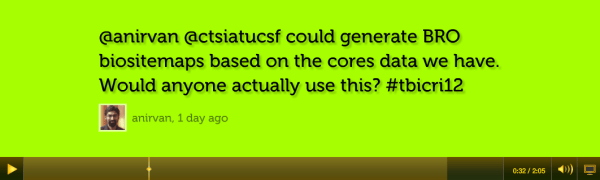
CTSI’s visibility on Twitter is growing – thanks to the tweets from CTSI programs and people like Anirvan (see his latest post AMIA 2012 Joint Summit: a report back in tweets).

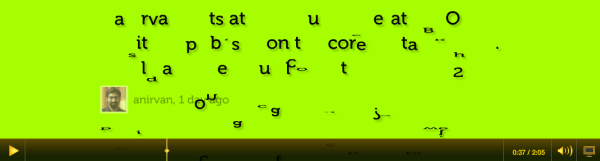
But how can we leverage and highlight this activity, for example at upcoming events (retreats, conferences, symposia, etc.)? Visible Tweets” is a great tool to do just that. Type in a search term, for example @CTSIatUCSF, and go…

Try it!

Tweets fly in and out… Here is an example.