Open Notebook Science

Sunday
Thinking about our recent posting  regarding project and document management, along with a number of postings on open source data, people might be interested in learning more about a movement that takes open source to a basic level.  As described in Wikipedia:

Open Notebook Science is the practice of making the entire primary record of a research project publicly available online as it is recorded. This involves placing the personal, or laboratory, notebook of the researcher online along with all raw and processed data, and any associated material, as this material is generated. The approach may be summed up by the slogan ‘no insider information’.

While not everyone thinks this is a great idea, a number of labs in a variety of disciplines have begun to embrace the concept.  Similar to the Creative Commons movement, there are a number of ways to implement open science in your lab (with associated logos, of course!).

So, does open notebook science have a place in biomedical research, and does it have a role in translational science?

Further reading:

Crowdsourcing for idea generation

Can big institutions get better ideas by including more people? High-profile crowdsourced ideation projects in our communities include:

  • Harvard Catalyst ran a contest last year, inviting Harvard and external community members to come up with their own answers to the question “what do we not know about Type 1 Diabetes?” They got over 190 responses. A panel of experts culled the list down to a dozen top award-winning ideas, and seven new projects have been funded to investigate these questions. Top ideas came from faculty, students, staff, and a patient.
  • The White House developed the SAVE Award, a national contest for federal government employees to suggest ways to make government processes cheaper and easier. The 2009 contest drew 38,000 entries, while the 2010 contest drew 18,000 entries, plus 160,000 votes. Winning ideas include not throwing away bulk medication at the VA, online scheduling at Social Security offices, and ending the mailing of print copies of the Federal Register. Check out the huge range of submitted ideas.
  • UCSF is running Bright Ideas, a campus-wide suggestion box. The campus community can share and vote on ideas. Previously-implemented Bright Ideas included a system to share unused office furniture and supplies, and the installation of audio signals for the visually impaired at Parnassus crosswalks.

(Image by Faith Grober)

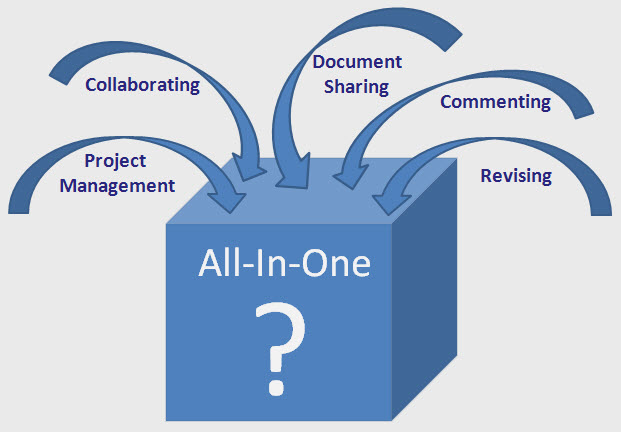
Researcher’s Bleg: Looking for a technical solution to enable project & document management, collaboration and revising

UCSF researcher Ralph Gonzales writes to get our advice regarding his Wiki-Whiteboard (or Wiki-Noteboard). Here is his description of what he is looking for:

Version 1.0. Lives on my iPad. A handwriting recognition program that allows one to organize documents into different notebooks (i.e., projects), and that allows one to attach different types of documents (Word, Powerpoint, PDF, scanned documents, etc.) to different locations on different pages and notebooks. Think about the “insert comment” function in Word… for this we would have an “Insert document” function. The mock-up/layout could actually resemble the word document, except instead it’s my handwritten notes with documents inserted. It would be nice to be able to insert documents directly from different sources such as email folders, as well has hard-drive.

Version 2.0. Lives on a server with all the same functions as above. Selected individuals could also access the specific Noteboards and provide comments to the notes or attached documents using something similar to “Track Changes” from Word… using the “Insert Comments section. You would have different colors for different individual’s comments.

Great question. Team, can we offer some ideas/recommendations?

Putting print books online

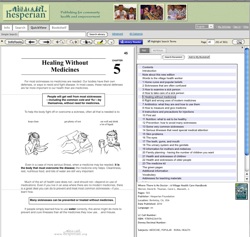
I’m a fan of the Hesperian Foundation, which publishes community-based healthcare books like Where There Is No Doctor. In addition to giving their books away at no or low cost, they’ve historically distributed gratis copies of their books in PDF format, chapter by chapter (example).

They’ve now set up a new online reading interface (vaguely similar to Google Books), but it’s Flash-based, and can’t be indexed via search engines. Is this an improvement?

Which of these online reading interfaces for print books do you like best?

(Update: fixed link)

Pharma and Social Media

Pharmaceutical companies continue to struggle with patient interactions in today’s social media environment.  While a number of pharma and biotech firms have a presence on social platforms, the conversation has traditionally been one-sided.  The companies speak, and the consumer can only listen.  However, that’s now starting to shift.

Pharma brand marketers that disable comments on their Facebook pages are in for a change. As predicted, Facebook will no longer allow pharma brands – which are typically highly risk averse when it comes to discussions about their drugs and products in social media environments – to turn off commenting on their pages.[via]

Part of the challenge is a regulatory one.  Industry continues to wait for guidance from the FDA on how social media should and should not be used.  Although the FDA held a hearing on this topic back in 2009, they continue to delay issuing any guidance (which was most recently supposed to be available in Q1 2011, but that didn’t happen).

For now, it seems that pharma and the social media providers must continue to work this out themselves.

Data anonymization: mission impossible?

Pete Warden discusses why anonymized social media datasets can be so easy to match up again:

“[T]his anonymization process is an illusion. Precisely because there are now so many different public datasets to cross-reference, any set of records with a non-trivial amount of information on someone’s actions has a good chance of matching identifiable public records. Arvind first demonstrated this when he and his fellow researcher took the “anonymous” dataset released as part of the first Netflix prize, and demonstrated how he could correlate the movie rentals listed with public IMDB reviews. That let them identify some named individuals, and then gave access to their complete rental histories. More recently, he and his collaborators used the same approach to win a Kaggle contest by matching the topography of the anonymized and a publicly crawled version of the social connections on Flickr. They were able to take two partial social graphs, and like piecing together a jigsaw puzzle, figure out fragments that matched and represented the same users in both.” (via)

(Photo by Ell Hind at Flickr)

The CDC takes on the zombie apocalypse

The CDC’s Public Health Matters blog posted a wonderful guide on how to prepare for the zombie apocalypse, starting off with a reference to zombie neurophysiology.

Conveniently, many zombie preparedness safety tips also carry over to other real-world dangers:

“In movies, shows, and literature, zombies are often depicted as being created by an infectious virus, which is passed on via bites and contact with bodily fluids. Harvard psychiatrist Steven Schoolman wrote a (fictional) medical paper on the zombies presented in Night of the Living Dead and refers to the condition as Ataxic Neurodegenerative Satiety Deficiency Syndrome caused by an infectious agent.

So what do you need to do before zombies…or hurricanes or pandemics for example, actually happen? First of all, you should have an emergency kit in your house. This includes things like water, food, and other supplies to get you through the first couple of days before you can locate a zombie-free refugee camp (or in the event of a natural disaster, it will buy you some time until you are able to make your way to an evacuation shelter or utility lines are restored). Below are a few items you should include in your kit, for a full list visit the CDC Emergency page.

  • Water (1 gallon per person per day)
  • Food (stock up on non-perishable items that you eat regularly)
  • Medications (this includes prescription and non-prescription meds)
  • Tools and Supplies (utility knife, duct tape, battery powered radio, etc.)
  • Sanitation and Hygiene (household bleach, soap, towels, etc.)
  • Clothing and Bedding (a change of clothes for each family member and blankets)
  • Important documents (copies of your driver’s license, passport, and birth certificate to name a few)
  • First Aid supplies (although you’re a goner if a zombie bites you, you can use these supplies to treat basic cuts and lacerations that you might get during a tornado or hurricane)”

Read the whole thing, before the undead hordes come for you.

Image credit

How Can We Make Biomedical Studies More Inclusive?

Even in 2011, persons with disabilities (more than 47 million Americans)
are still “ profoundly underrepresented in mainstream health research”. In their recent article, the researchers Ann Williams and Shirley Moore propose a “Universal Design of Research” (UDR), which allows “routine inclusion of persons with disabilities in studies, without the need for adaptation or specialized design.”

They offer a few guidelines and ideas to support researchers in designing materials in accessible formats. Some good food for thought as the new UCSF Participant Recruitment Service (PRS) takes shape. Here is what they propose:

… provide multisensory, flexible options for recruitment, research instruments (such as questionnaires), measurements, and responses from participants, with reasonable accommodations that invite and facilitate participation by persons with disabilities; and when you do not know how to include someone with a disability, consult someone who does (the potential research participant, another person with that disability who is knowledgeable about the range of methods people use for living fully with it, or a professional who works with persons who have that disability). 

Practical guidelines for implementing the Universal Design of Research include:

… (i) plan multiple options for people to learn about, respond to, and arrive at opportunities to participate in research; (ii) provide multiple means to communicate the information in research instruments and instructions for participants; and (iii) provide multiple means of responding to research instruments and self-management interventions.

I wonder what our PRS team thinks about these ideas. And, do we know of other successful approaches, web-based technologies or great examples we could share?  Ann Williams and Shirley Moore are looking for ideas to develop comprehensive guidelines.

Google for Data?

When we think of searching the web for information, our thoughts (or at least mine) usually turn to Google.  However, if you’re looking for numeric data rather than text, a new search engine called “Zanran” might be a better place to start.

Zanran helps you to find ‘semi-structured’ data on the web. This is the numerical data that people have presented as graphs and tables and charts. For example, the data could be a graph in a PDF report, or a table in an Excel spreadsheet, or a barchart shown as an image in an HTML page. This huge amount of information can be difficult to find using conventional search engines, which are focused primarily on finding text rather than graphs, tables and bar charts. [via]

One nice trick: Hover your mouse over the icon on the left-hand side of the search results, and you’ll see a preview image containing your search term.

Read more: