ScienceSeeker – A Better Way to Keep Informed?

For those of us interested in staying on top of the latest news in science, reading blogs can be a daunting task.   As Bora Zivkovic recently wrote on the Scientific American blog:

Over the years, the science blogosphere exploded in size. There are now thousands of science blogs (in many languages) and nobody can keep up with all of them. Thus, by this time last year, Scienceblogs.com was containing only a miniscule proportion of the science blogging community, and it is quite possible that it was not as representative as it used to be. Yet it was still a one-stop-shopping destination for many, including for the media.

Earlier this year, an interesting new science blog aggregator site started.  Called ScienceSeeker, it attempts to collect “science reporting, analysis, and discussion” in one place.  As they write on their “About” page:

ScienceSeeker is our effort to fill that void. We have collected hundreds of blogs in one place, and invite you to submit even more. Our goal is to be the world’s most comprehensive aggregator of science discussions, all organized by topic.

This site is a work in progress. Consider it to be the first step in our effort. Blogs are categorized according to a fixed list of topics. You can see lists of posts from those blogs, but since many bloggers have wide-ranging interests, some of the topics might not quite fit. Ultimately we plan on categorizing not by blog, but by individual post. We hope to have other ways of arranging posts as well: just the best posts, chosen by experts; the most popular posts; posts about particular events.

Do sites like this help get information out faster, or does it all get lost in the noise?  How do you keep track of the myriad of blog postings?

“Search Needs a Shake-Up: From Simple Document Retrieval to Question Answering”

If you are thinking about making Internet trawling more efficient, take a look at the recent perspective published in Nature. Researcher Oren Etzioni (whose lab introduced open information extraction) “calls on researchers to think outside the keyword box…”

Open information extraction obviates topic-specific collections of example sentences, and instead relies on its general model of how information is expressed in English sentences to cover the broad, and unanticipated, universe of topics on the Internet.

The basic idea is remarkably simple: most sentences contain highly reliable syntactic clues to their meaning. For example, relationships are often expressed through verbs (such as invented, married or elected) or verbs followed by prepositions (such as invented by, married to or elected in). It is often quite straightforward for a computer to locate the verbs in a sentence, identify entities related by the verb, and use these to create statements of fact. Of course this doesn’t always go perfectly. Such a system might infer, for example, that ‘Kentucky Fried Chicken’ means that the state of Kentucky fried some chicken. But massive bodies of text such as the corpus of web pages are highly redundant: many assertions are expressed multiple times in different ways. When a system extracts the same assertion many times from distinct, independently authored sentences, the chance that the inferred meaning is sound goes up exponentially.

Much more research has to be done to improve information-extraction systems — including our own. Their abilities need to be extended from being able to infer relations expressed by verbs to those expressed by nouns and adjectives. Information is often qualified by its source, intent and the context of previous sentences. The systems need to be able to detect those, and other, subtleties. Finally, automated methods have to be mapped to a broad set of languages, many of which pose their own idiosyncratic challenges.

One exceptional system — IBM’s Watson — utilizes a combination of information extracted from a corpus of text equivalent to more than 1 million books combined with databases of facts and massive computational power. Watson won a televised game of Jeopardy against two world-class human players in February this year. The multi-billion dollar question that IBM is now investigating is ‘can Watson be generalized beyond the game of Jeopardy?’

The “first follower” is as important as the leader

 I was forwarded a great video from Opinder Bawa (UCSF’s CTO) today —  here’s the video and Opinder’s lead in. 

Kevin Grumbach mentioned in conversation the wonderful 5 minute video from a Ted talk about how being a “first follower” is as important as being a leader.

 Do check out the link below and I think you will find it as relevant as I did for what we are trying to do with team research, community engagement, health professional education, health care teamwork and the like.

Google Scholar Citations – an easy way to get citation metrics into UCSF Profiles?

Recently Google launched Google Scholar Citations: a simple way for you to compute your citation metrics and track them over time, per this blog post.

I went in to check it out on July 25, 2011 and ‘signed up’ – and here’s what I found. NOTE: apparently this is a limited launch with a small number of users, so if you can’t sign up, you can provide your email address to be notified when they open it up to everyone.

1. I went to: http://scholar.google.com/citations?view_op=new_profile

2. I logged into my Google account and then followed their 4 step process of claiming my citation profile. Here are the steps:

3. Step 1 was creating the Google scholar Profile – this entailed putting in my name, title, institution email address. (sorry no screen shot).

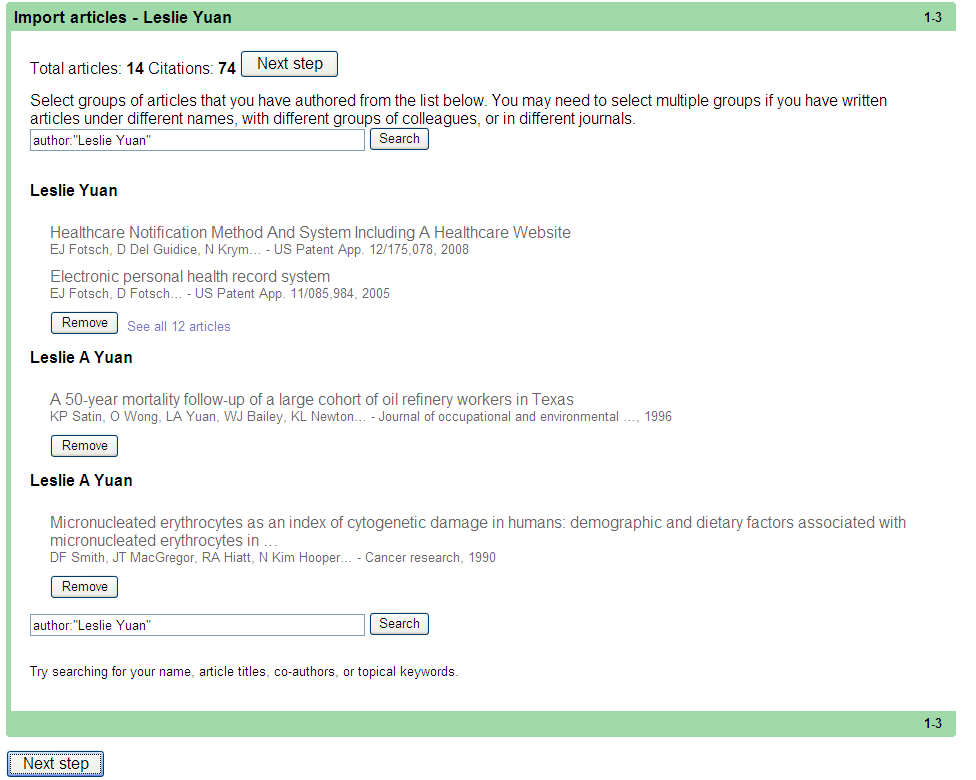
4. Step 2 is to import “Your articles.” The system automatically shows me what it found and then I went in to “claim” which articles were mine. Once I click the “This is mine” button next to every article that is mine, the button changes to “Remove” (if I want to change my mind). A few notes here:

a. The Google search found my articles in PubMed, and also some patent applications, but I know I had one article that isn’t it PubMed and this one was not found.

b. It was easy for me to claim my articles as I only had 3 items. For people with hundreds of articles to claim, I’m not sure how easy they make it to claim your work.

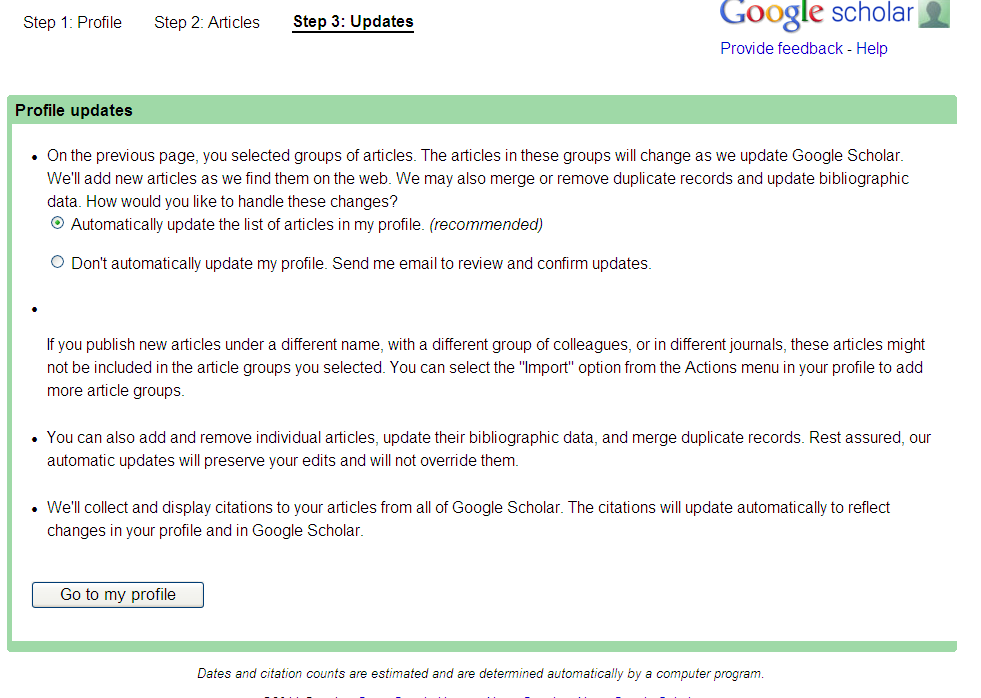
5. Step 3 is to configure your updates for Google scholar

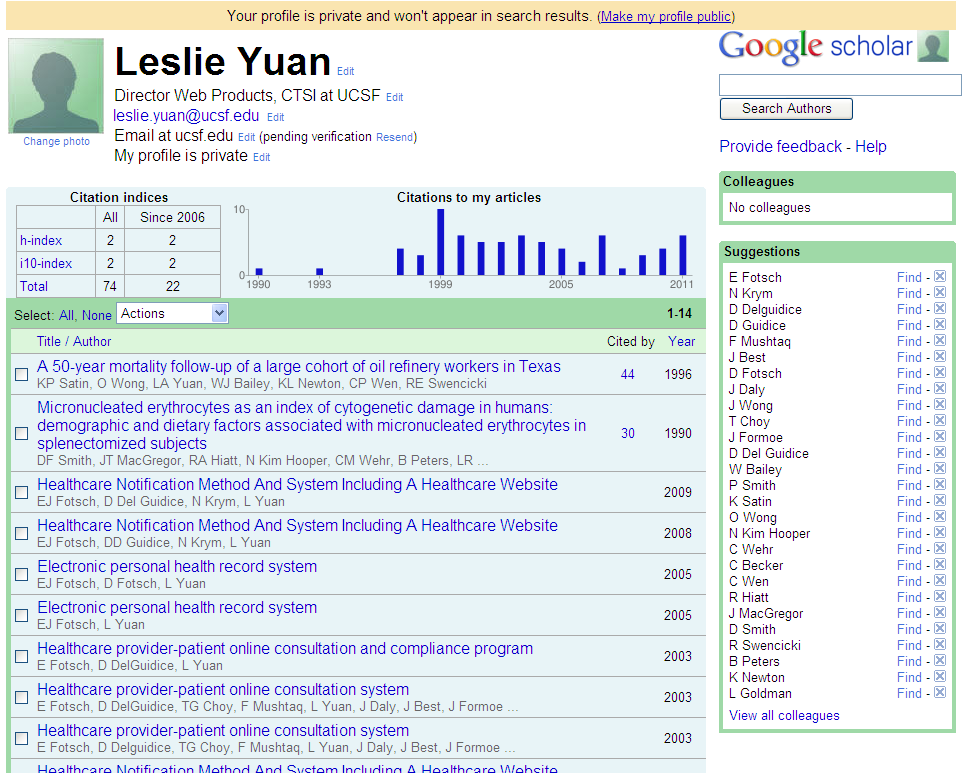
6. Step 4 – Go to view your profile, which is private by default. Change this to public if you want others to find it (and if you want to create a link to it from your UCSF Profile)

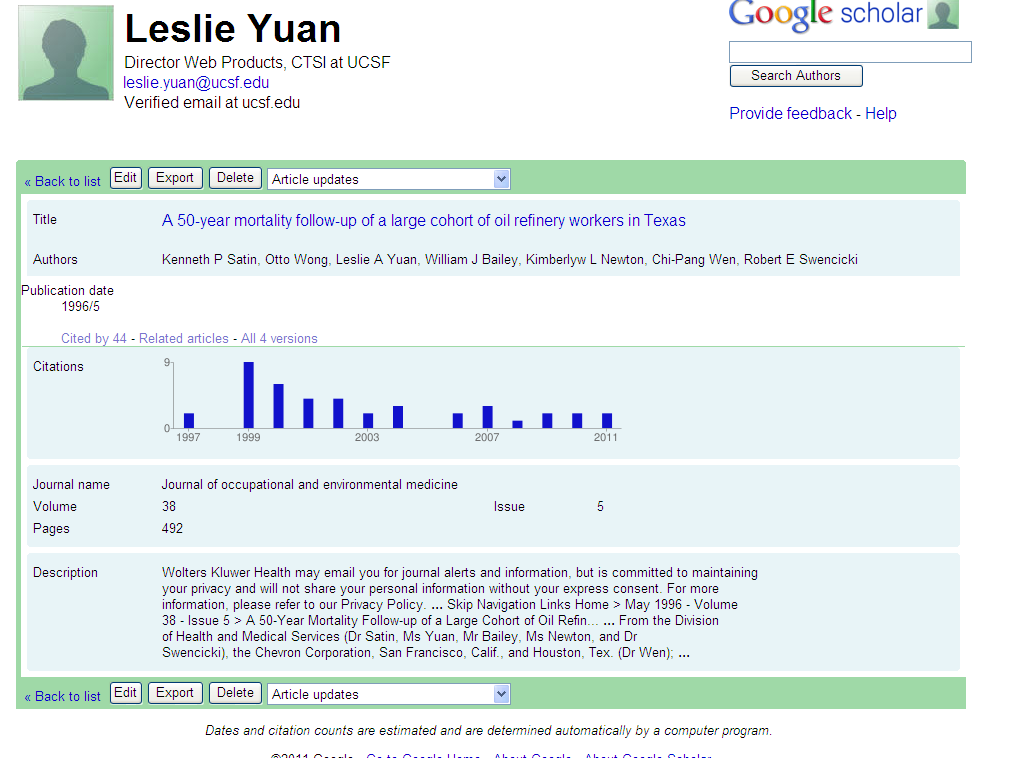
Clicking on a specific article gets you to:

7. If you’ve made your Google Scholar Profile public, you can grab this Google URL and easily create a link to citation metrics in your UCSF Profile. Log in to UCSF Profiles and edit the Websites associated with your profile. See a screenshot of mine below, or view it live.

We’ve got some other ideas on how this work can intersect with UCSF Profiles and our work with research networking tools … in more robust ways than this. But in less than 10 minutes, I was able to do the above.

Café Conversation: Chocolate and Silkworms

You can find me just about every morning at the Café Pacifica having my just-plain-old black coffee and not-so-plain conversation with the early crew – my cafe “homeys”. From time to time, I hear the most amazing stories, one of which I want to share here.


What is the connection between chocolate and silkworms? The  connection is awesome learning!

One of my crew, Deb, volunteers at a middle school, and works with students in the special education program. The teacher for this very fortunate group finds creative and engaging ways to help her students learn. Here are two examples of her “stealth” education:

Chocolate

Students are assigned to bring in their favorite family chocolate recipe (just the recipe – not the actual yummy). After a few days, students are invited to verbally share a little about their recipe in “Show and Tell”. Next, they are assigned to write a short report about the recipe – where it came from, who makes it, when the family enjoys this treat (holidays, birthdays, rainy days, whenever), and what the student likes about this variation on the chocolate theme.

Then the recipes are converted into arithmetic problems. You are having a party and you are going to have 12 guests. The recipe makes enough for 6 people. Rewrite the recipe doubling all the ingredients. A worksheet is distributed for homework – color in the measuring spoons or measuring cups for  each ingredient.

Another activity has students trading recipes – find someone who has a recipe similar to yours – find someone who has a recipe very different from yours.

Finally, students go to the home-ec room and make some of the delicacies. I hear that other students from the school flock to the chocolate sale table to purchase goodies from the special-ed students.

Silkworms

The same group of lucky special education students spends an entire year caring for and observing silkworms. When the silkworm shipment arrives, learners divide into small groups. Given all the supplies needed to set up their silkworm farms, students work with guidance from the classroom volunteers to make happy homes for their voracious and productive pets. The small groups are tasked with feeding and harvesting, maintaining a weekly log, and keeping the silkworm environments happy and healthy. Students keep individual journals, and occasionally share their journals with each other.

In addition to the types of engaging activities with the chocolate project, silkworms add learning topics such as biology, ecology, and EEK! even sex education and reproduction.

Our Challenge

I hear you thinking, “Nice story, Chris, but what does this have to do with graduate school?” I argue that these rich types of learning opportunities have everything to do with graduate school. What if we were to identify the desired learning outcomes, consider focus and level of complexity, and then design activities and assignments that are meaningful, relevant, and multi-dimensional?

And, oh by the way, fun is a good idea, too.

So if it’s not chocolate or silkworms, what have you, are you, or might you do for some “stealth learning”?

From eLearning to WeLearning

When you think about online education, what comes to mind? I often hear things like:

  • I don’t like online learning — I like to be in the classroom where I can interact with other students.
  • I’m too social for online learning — online learning is too isolating and lonely.
  • Online learning is boring.

How about you? Share your preconceptions about online learning by commenting on this post.

Online learning is also known as eLearning (electronic learning). But let’s consider a different proposition. What if we engage in WeLearning rather than eLearning, or even iLearning?

iLearning (“I” Learning) — I want or need to learn something. I get on my computer or smart phone. I “Google” or use some more scholarly search tool to look up the information I am seeking. I choose from the available sites and information that seem to meet my learning needs. I learn what I need to know, and I might even discover related topics I didn’t expect would pique my interest.

eLearning (one example) — My employer requires periodic training on topics sucs as sexual harassment, human subject research, or HIPPA. I receive an email message informing me that I must complete the training online by some specific date. I log in and work through the units — slides that cover the material, with an occasional multiple choice question to check my knowledge.

WeLearning — I elect to take a course online. The course is billed as collaborative. I log on the first time and am asked to post my introduction. I read and reply to a few introductions posted by others, and our conversation begins. Soon, we become a community of learners. We are expected to use forums to sustain ongoing dialogue. We are expected to post assignments and then give and receive feedback among our scholar colleagues and faculty. We may be required to complete group projects. We learn with and from one another.

There is a time and a reason for each of these models, and many more. Designing Clinical Research for Students and Residents ONLINE is WeLearning.

CTSI Embarks on Fully Asynchronous Online Learning Journey

August 1, 2011 marks the official start date for Designing Clinical Research (DCR) for Students and Faculty. The majority of scholars will assemble on Monday and Wednesday mornings in the traditional lecture hall at the Parnassus campus. Twenty self-selected learners will take the course completely online via the UCSF Collaborative Learning Environment, AKA Moodle.

The online course site was made available to students at noon on Tuesday, July 19. At 4:14 pm that same day, the first student logged in, explored the site, and posted an introduction. By 6:00 pm, two more students showed up and began to interact with each other. Remember! The course does not officially begin until August 1.

This course about research also doubles as research. Co-faculty, Kirsten Bibbins-Domingo, MD, PhD and Deborah G. Grady, MD, MPH along with researchers, Sarah Wilson, MD and Lawrence Haber, MD, as well as instructional designer and online learning consultant, Chrisanne N. Garrett, MAED will study the first offering of the online course. This small pilot study aims to answer the following question: how do learning outcomes, including knowledge and skill acquisition, and learner satisfaction compare between health science students who take the online DCR course and students in the traditional course?

The DCR course is structured to foster the development of students’ ability to write a clinical research proposal. For the final assignment, students write a five page proposal of their research study. We plan to take the twenty proposals written by the online students and compare them to twenty proposals randomly selected from the traditional course. Two K Program scholars, blinded to the author of the proposal, will read all forty proposals and rate the proposal based on the NIH scale of 0-9. We will then compare the scores of the online students to the scores of the traditional students. Additionally, we will collect formative and summative evaluation data from the online learners on both learning progress and satisfaction with the online learning environment.

This blog will serve as an ongoing report on the online course and, ultimately, on the results of the research study. Your questions and comments are most welcome.