 For those of us interested in staying on top of the latest news in science, reading blogs can be a daunting task. As Bora Zivkovic recently wrote on the Scientific American blog:
Over the years, the science blogosphere exploded in size. There are now thousands of science blogs (in many languages) and nobody can keep up with all of them. Thus, by this time last year, Scienceblogs.com was containing only a miniscule proportion of the science blogging community, and it is quite possible that it was not as representative as it used to be. Yet it was still a one-stop-shopping destination for many, including for the media.
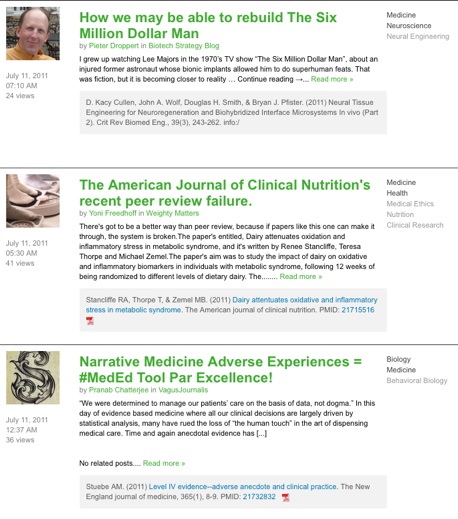
Earlier this year, an interesting new science blog aggregator site started. Called ScienceSeeker, it attempts to collect “science reporting, analysis, and discussion” in one place. As they write on their “About” page:
ScienceSeeker is our effort to fill that void. We have collected hundreds of blogs in one place, and invite you to submit even more. Our goal is to be the world’s most comprehensive aggregator of science discussions, all organized by topic.
This site is a work in progress. Consider it to be the first step in our effort. Blogs are categorized according to a fixed list of topics. You can see lists of posts from those blogs, but since many bloggers have wide-ranging interests, some of the topics might not quite fit. Ultimately we plan on categorizing not by blog, but by individual post. We hope to have other ways of arranging posts as well: just the best posts, chosen by experts; the most popular posts; posts about particular events.
Do sites like this help get information out faster, or does it all get lost in the noise? How do you keep track of the myriad of blog postings?



 BioMed 2.0