AMIA 2012 Joint Summit: a report back in tweets

Eric, Leslie, and I from CTSI at UCSF’s Virtual Home team spent the past three days at the AMIA 2012 Joint Summit in San Francisco.

Here’s some of what was happening on the researcher networking, social networking, knowledge representation fronts, and public search front, via Twitter:

Other tweets that caught my eye from the rest of the conference:

Embedding OpenSocial in Moodle

The CTSI team uses Moodle for online learning, and OpenSocial to embed applications into UCSF Profiles.

Lausanne-based doctoral student Evgeny Bogdanov recently combined the two, turning Moodle into an OpenSocial container. He describes how he embedded OpenSocial into Moodle by developing a Moodle plugin that interfaces with Apache Shindig:

“We present here a plugin that allows to bring OpenSocial gadgets into Moodle. OpenSocial gadgets are rendered via Apache Shindig (extension of version 2.0 that supports Spaces). Moodle is a Learning Management System used in many Educational Institutions (Universities) to manage courses. It is a plugin based PHP application that can be extended by installing additional modules…There are two different OpenSocial plugins for moodle.…This plugin was developed within the ROLE Integrated Project and is already used in 5 courses at Shanghai Jiao Tong University.”

 Read more:

Boosting focus with the Pomodoro technique

Italiano: Autore: Francesco Cirillo rilasciata...

Pomodoro timer (Image via Wikipedia)

I sometimes find myself overwhelmed by tasks and projects, and find it useful to chunk up my work into focused sprints during a fixed time frame—a concept used both in software development and in various time management practices.

I’ve been finding myself using the Pomodoro technique, a fancy name for doing 25-minute sprints punctuated by 5-minute intervals.

There are a wide variety of simple Pomodoro timers available:

What techniques do you use to maintain focus while juggling projects?

Measuring total scholarly impact, beyond the cite

The new Total-Impact tool takes a series of references to someone’s work (e.g. publications, Slideshare slides, URLs, Github or Mendeley accounts) and generates reports based on a wide variety of impact metrics. It starts with traditional citations, but adds in bookmarks (from Mendeley, Delicious, etc.), mentions (on Twitter, Facebook), downloads (from publishers’ websites).

Check out some examples:

It’s fun seeing the various metrics. Chad, for example, has work cited on Wikipedia, and read on Mendeley:

This 2011 entry from Clay’s report doesn’t appear to have any cites from PubMed, but shows interest and activity from a variety of sources, including the PLoS website, CrossRef, CiteYouLike, and Mendeley. Some of his papers have even been discussed on Facebook!

Read more:

Features vs. benefits

Perl‘s my language of choice. Perl’s a dynamic computer language, similar to Python or Ruby. There’s very little that you can do in Perl that other languages can’t do as well, but it has one huge killer feature—CPAN, a community-curated archive of tens of thousands of bits of pre-written open source code libraries. Without CPAN, Perl is just another language. With CPAN, Perl is a power tool that lets you deliver results lickety-split.

Perl developer chromatic breaks down the distinction between features and benefits when marketing Perl:

“The high point of the book so far—a technique I’ve used on three projects in the past week to great results—is to distinguish between technical features and customer benefits. In other words, while experienced Perl masters might say “Perl 5 is great because you have access to the CPAN”, that’s a feature. The benefit is that “80% of most programs has already been written”…While the as-yet unlaunched value analysis site a couple of us are launching for small investors has the technical feature “updates analysis after market close every day”, the benefit to customers is “gives you the best advice possible whenever you check it”.…My experience so far has been that the exercise of comparing features to benefits takes some time, but yields great results. Try it yourself; it’s easy. Grab a piece of paper and make two lists. On the left side, write all of the distinct technical features you consider worth mentioning. When you finish, write on the right side a benefit from the customer or user point of view corresponding to that technical feature. Sometimes there’s overlap, and that’s okay.” [via]

Read more:

How social proof works

We trust products and ideas that other people trust. Aileen Lee breaks down how social proof works in a guest piece on TechCrunch, breaking down the following categories:

Expert social proof

doctors for medicare

Celebrity social proof

Yao Ming

Individual user feedback social proof

Critical reviews (365:009)

Aggregate popularity social proof

Too many served

Friends’ recommendation social proof

Facebook hopes social proof with motivate users to clean their database

Read more:

Personalized email checklist

As we consider the role that personalized email might play in helping connect people to our services, it’s useful to look at Matthew Hayes’ simple three-point checklist on adding value to personalized email communications. An excerpt:

“The best two sources of data to use for versioning are declared data (preference center/welcome program) and behavioral data (browsed and click data). A component of regular, calendared email marketing should be relevant. Preference center data is the most relevant at time of action or update. Integrate this data into welcome series emails when they have just selected their preferences. Another clear action that begs for follow-up is when customers update their profile. Deliver a tailored communication stream according to their updates to bring greater relevance to your communications with them.  Browsed and clicked data, although harder to implement, can give you the biggest response return. Try versioning a component of the message based on recent website browsed data and recent email clicked data. Both sources will add value to a component of regular communication.”

[Link]

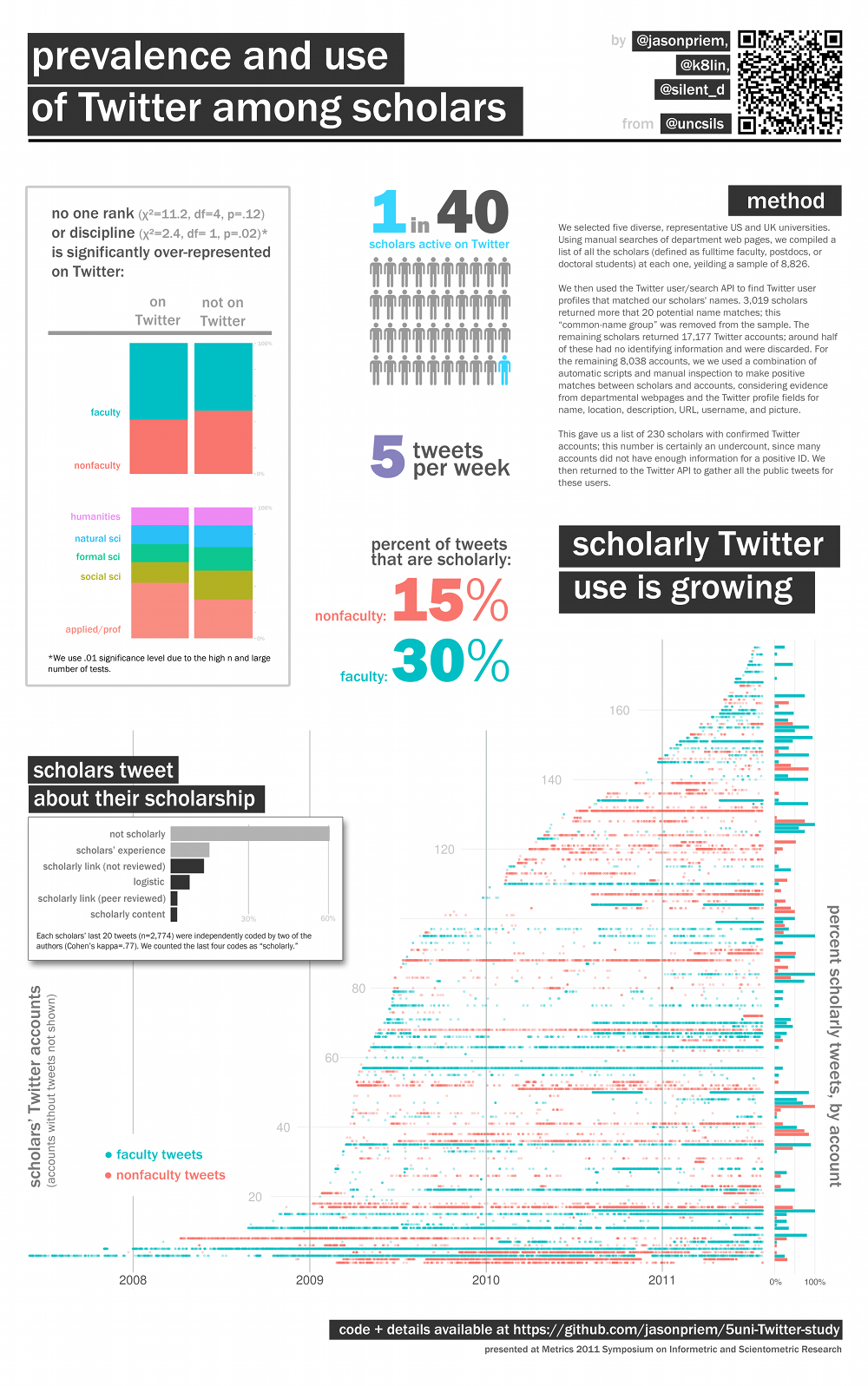
Surprise: Twitter unpopular with scholars

Jason Priem, Kaitlin Costello, and Tyler Dzuba, graduate students from UNC, examined Twitter usage for over 8000 scholars from five American and British universities.

The results? Sorry Twitter. Scholars are just not that into you.

Read more:

The importance of birthdays

Birthday Cake

"Birthday cake" by Will Clayton, Flickr

How important are birthdays? Computer scientist Latanya Sweeney‘s work quantifies the importance of knowing someone’s date of birth when trying to re-identify partially de-identified data. She’s written a series of papers showing how multiple non-name attributes can work together to serve as functional identifiers when matched against publicly available databases like voter lists or public hospital visit data. Per her research, she estimates that:

  • 87% of Americans can be uniquely identified by the combination of date of birth, gender, and ZIP code
  • 53% of Americans can be uniquely identified by the combination of date of birth, gender, and city
  • 18% of Americans can be uniquely identified by the combination of date of birth, gender, and county

However, substituting year of birth for the full day-month-year:

  • 0.04% of Americans can be uniquely identified by the combination of birth year, gender, and ZIP code
  • 0.04% of Americans can be uniquely identified by the combination of birth year, gender, and city
  • 0.00004% of Americans can be uniquely identified by the combination of birth year, gender, and county

Read more:

Open data projects should start with user needs

Open data projects need to cross a utility/relevance chasm before they gain uptake. Tom Steinberg of MySociety, a prominent UK civic app development team, argues that app contests and hack days aren’t enough—you need to focus on concrete projects, laser-focused on real user needs.

Why is a user focus critical?

“What people never, ever do is wake up thinking, ‘Today I need to do something civic,’ or, ‘Today I will explore some interesting data via an attractive visualisation.’ MySociety has always been unashamed about packaging civic services in a way that appeals directly to real people with real, everyday needs. I gleefully delete the two or three emails a year that land in our inbox suggesting that FixMyStreet should be renamed to FixOurStreet. No, dude, when I’m pissed it’s definitely my street, which is why people have borrowed the name around the world.

“We learned this lesson most vividly from Pledgebank, a sputtering site with occasional amazing successes and lots and lots of “meh.” The reason it never took off was because, unlike the later (and brilliant) Kickstarter, we didn’t make it specific enough. We didn’t say “use this site to raise money for your first album,” or “use this site to organise a march.” We said it was a platform for “getting things done,” and the users walked away in confusion. That’s why our new site is called FixMyTransport, even though it’s actually the first instance of a general civic-problem-fixing platform that could handle nearly any kind of local campaigning.”

That might mean, Tom argues, that it makes sense to bet bigger on fewer horses:

“MySociety got lucky…its second ever grant was for…about a quarter of a million dollars. It was amazing luck for a small organisation with no track record…Those days are gone…but governments everywhere should note that that funding of this scale got us right through our first couple of years, until sites like WriteToThem were mature and had proved their public value (and picked up an award or two).

“In the subsequent few years, we saw the ‘thousand flowers bloom’ mentality really take over the world of public-good digital funding, and we saw it go way beyond what was sensible. Time and again, we’d see two good ideas get funding and eight bad ones at the same time because of the sense that it was necessary to spread the money around. It would be great if someone could make the case to public grant funders that good tech ideas — and the teams that can implement them — are vanishingly rare. There is nothing to be ashamed about dividing the pot up two or three ways if there are only a few ideas or proposals or hacks that justify the money. The larger amounts this would produce wouldn’t mean champagne parties for grantees, it would mean the best ideas surviving long enough to grow meaningful traffic and learn how to make money other ways. After a long road supported by public grant funding, mySociety is now 50% commercially funded and 50% private-grant funded, but we’d never have arrived there without being 100% public-grant funded for the first couple of years.” (source)

Read more: