Crowdsourcing the Analysis and Impact of Scholarly Tweets

“Twitter is one of the fastest tools to discover newly published scholarly papers”, Martin Fenner wrote in one of his earlier posts. Now Fenner and Euan Adie finished the first phase of an interesting new experiment, the CrowdoMeter project.

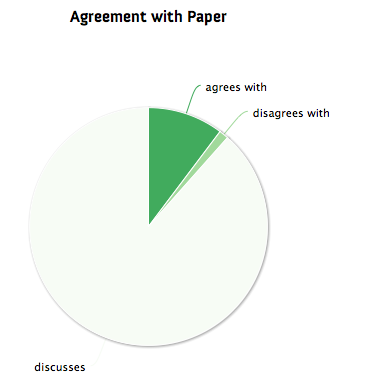
In the last 2 months, they used crowdsourcing to analyze the semantic content of almost 500 tweets linking to scholarly papers (953 classifications by 105 users for 467 tweets). Their preliminary results show: 

  • 3 predominant subject areas: Medicine and Health, Life Sciences, and Social Sciences and Economics.
  • Most tweets (88%) discussed the papers, 10% were in agreement, 3% disagreed.
  • Most papers are not tweeted by their authors or publishers

In his recent guest post on Impact of Social Sciences, Fenner makes the argument that “social media, and Twitter in particular, provide almost instant, relevant recommendations as opposed to traditional citations.

A few years from now the ‘personalized journal’ will have replaced the traditional journal as the primary means to discover new scholarly papers with impact to our work.

What is still missing are better tools that integrate social media with scholarly content, in particular personalized recommendations based on the content you are interested in (your Mendeley or CiteULike library are a good approximation) and the people you follow on Twitter and other social media.

Fenner’s view is also based on Gunther Eysenbach’s study from 2011 that showed “highly tweeted papers were more likely to become highly cited (but the numbers were to small for any firm conclusions; 12 out of 286 papers were highly tweeted)”.

Fenner and Adie are using altmetric.com to track the scholarly impact of your research. Other tools – some of which we wrote about – include  ReaderMeterTotal ImpactPLoS Article-Level Metrics, and ScienceCard.

“From Twitter To Tenure”: MD Shares How Twitter Can Be A Valuable Tool For Academics

Credit: Jason Archer, http://www.academictechnology.org

There is still considerable resistance to embracing social media tools for academic purposes, but if you are reading this blog post on FutureDocs by Vineet Arora, MD,  you are probably willing to consider their positive effects. And the list of academic tweeters is growing.

Vineet shares the various ways social media has impacted her academic career including finding grant opportunities, disseminating research results, and being found as an expert for media interviews and lectures. Here is her list:

  • Media interviews – I was interviewed by Dr Pauline Chen through the New York Times who located me through – you guessed it Twitter!  She actually approached me for the interview by direct messaging me through Twitter.  She was following me and noticed my interests in handoffs on my Google profile which is linked to my Twitter account.  She was also very encouraging when I started the blog which was exciting!
  • Workshop presentations– I presented a workshop on social media in medical education (#SMIME as we like to call it), at 2 major medical meetings with 3 others (including @MotherInMed who encouraged me to start a blog and also is my copresenter at SGIM).  The idea was borne on Twitter…and the first time I actually met one of the workshop presenters (who I knew on Twitter) was at the workshop.
  • Acquired new skills  – My workshop co-presenter who I only knew through Twitter ended up being Carrie Saarinen, an instructional technologist (a very cool job and every school needs one!).  She is an amazing resource and taught me how to do a wiki.  After my period of ‘lurking’, I started my own ‘course’ wiki  dedicated to helping students do research and scholarly work which we are launching in a week.
  • Lecture invitations – Several of my lecture invitations come through social media.  Most notably, I was invited to speak for an AMSA webinar on handoffs and also speak to the Committee of Interns and Residents on teaching trainees about cost conscious medicine.  Both invitations started with a reference to finding me through Twitter or the blog.
  • Committee invitations – I am now on the SGIM communications task force as a result of my interest in social media.  Our most recent effort was a piece about‘tweeting the meeting’ with @medrants and an older piece focused on the top Twitter Myths and Tips.
  • Grant opportunities – I recently submitted a grant with an organization that I learned of on Twitter – Initially, I had contacted Neel Shah from Costs of Careasking him if they had a curriculum on healthcare costs.  They did not, but were interested in writing a grant to develop a curriculum so they brought my team on board and we submitted together (fingers crossed).
  • Dissemination – One of the defining features of scholarship (the currency of promotion in academic medical centers) is that it has to be shared.   Well, social media is one of the most powerful ways to share information.   In a recent example, we entered a social media contest media video contest on the media sharing site Slideshare.  Using social media, we were able to obtain the most number of ‘shares’ on Facebook on Twitter which led to the most number of views and ultimately won ‘Best Professional Video.’  To date, this video, has received over 13,000 views, which I was able to highlight as a form of ‘dissemination’ in a recent meeting with our Chairman about medical education scholarship.    While digital scholarship is still under investigation with vocal critics and enthusiasticproponents debating the value of digital scholarship in academia, digital scholarship does appear to have a place for spreading nontraditional media that cannot be shared via peer review.

Further reading:

Social Media Week, February 2012

Organizers host the five-day conference (February 13-17, 2012) simultaneously in London, Berlin, New York, Toronto, San Francisco and São Paulo. 

The event will explore the impact that social media has on culture, business communications and society at large.

Among the topics:

  • Mining Social Media for Consumer Insight
  • Dashboards and Metrics
  • Topical Influencers: Who Are They and How Do We Reach Them?
  • Creating Social Utilities That People Will Actually Use

More at http://socialmediaweek.org/

Measuring total scholarly impact, beyond the cite

The new Total-Impact tool takes a series of references to someone’s work (e.g. publications, Slideshare slides, URLs, Github or Mendeley accounts) and generates reports based on a wide variety of impact metrics. It starts with traditional citations, but adds in bookmarks (from Mendeley, Delicious, etc.), mentions (on Twitter, Facebook), downloads (from publishers’ websites).

Check out some examples:

It’s fun seeing the various metrics. Chad, for example, has work cited on Wikipedia, and read on Mendeley:

This 2011 entry from Clay’s report doesn’t appear to have any cites from PubMed, but shows interest and activity from a variety of sources, including the PLoS website, CrossRef, CiteYouLike, and Mendeley. Some of his papers have even been discussed on Facebook!

Read more:

How social proof works

We trust products and ideas that other people trust. Aileen Lee breaks down how social proof works in a guest piece on TechCrunch, breaking down the following categories:

Expert social proof

doctors for medicare

Celebrity social proof

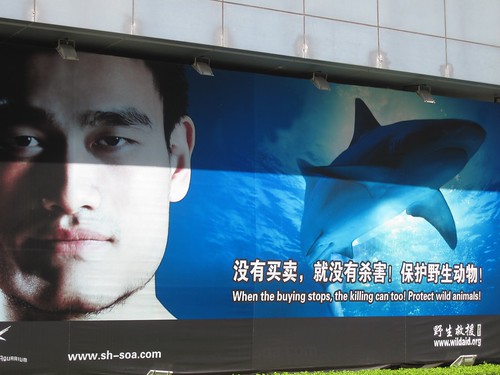
Yao Ming

Individual user feedback social proof

Critical reviews (365:009)

Aggregate popularity social proof

Too many served

Friends’ recommendation social proof

Facebook hopes social proof with motivate users to clean their database

Read more:

Why Do Americans Use Social Media?

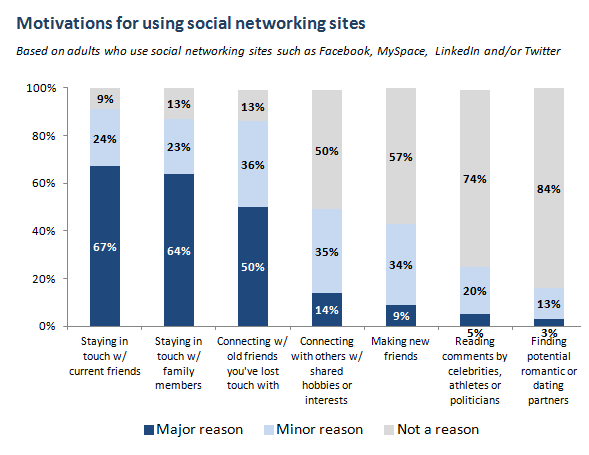
These days, “66%, two-thirds of online adults, use social media platforms such as Facebook, Twitter, MySpace or LinkedIn,” states the latest  PEW Research report.  And while we are thinking about how we can leverage social media at academic institutions to support research, for example to foster internal communication and knowledge sharing, the report adds numbers to some of the known reasons that motivate people to use social media.

(The 66%) say that connections with family members and friends (both new and old) are a primary consideration in their adoption of social media tools. Roughly two thirds of social media users say that staying in touch with current friends and family members is a major reason they use these sites, while half say that connecting with old friends they’ve lost touch with is a major reason behind their use of these technologies.

Other factors play a much smaller role: 14% of users say that connecting around a shared hobby or interest is a major reason they use social media and 9% say that making new friends is equally important. Reading comments by public figures and finding potential romantic partners are cited as major factors by just 5% and 3% of social media users, respectively.

See the full report for more details, including differences among age and ethnic groups when it comes to what they value most in social media.

Notes from the 2011 Medicine 2.0 Summit at Stanford

Some argue that as technology advances it turns into a barrier and prevents essential human interactions, such as at the bedside. Even though this is a concern that we need to address, the Medicine 2.0 Summit 2011 provided a lot of examples that showed how technology can turn into a powerful mediator.

For those interested who did not get the chance to attend the event, here is a list of the main topics and initiatives presented that use social media, mobile computing applications, as well as Web 2.0 in healthcare and medicine to create new ways for people to connect. Please feel free to add your impressions and ideas of the summit and conference. Thanks!

1. If you are interested in learning from ePatients on how to build and leverage communities of practice and participatory medicine, you might want to explore the following blogs and platforms: 

  • Amy Tenderich’s blog Diabetesmine.com,
  • SmartMobs, authored by Howard Reingold, who was diagnosed with colon cancer and shared his experience on a blog called Howard’s Butt
  • PatientsLikeMe, where more than 115,000 members with over 1,000 conditions share their experiences to see what interventions are working for others

2. Patients have been connecting for some time. However, how can we help connect physicians and patients in a meaningful way? During the session “The Healthcare Transformers”, the panelists presented their views on personalizing healthcare and new ways for physicians and patients to communicate. 

  • Jay Parkinson, founder of HelloHealth and Futurewell, shared his passion about using creative design to improve health — and a few critical lessons learned (including” innovation is lonely” and “colleagues are critics”) as he and colleagues opened a “virtual clinic”, a “web-based patient communication, practice management and electronic health record in one solution”.
  • Lee Aase from the Mayo Clinic Center for Social Media gave a very entertaining talk on social media in the spirit of “Suus non ut Difficile” (It’s not that hard).  See one of their latest success stories: “When Patients Band Together – Using Social Networks To Spur Research for Rare Diseases”. They are very proactive about arming their health care professionals with the right tools to leverage social media for their successful communication. They even started a “Social Media Residency”. Aase also introduced the Social Media University, Global (SMUG), a post-secondary educational institution dedicated to providing practical, hands-on training in social media to lifelong learners.
  • Bryan Vartabedian, pediatric gastroenterologist, writes an interesting blog 33charts  about “the convergence of social media and medicine”.
  • Wendy Sue Swanson, practicing pediatrician, mother, and author of SeattleMamaDoc, walks a fine line and shares resources and methods that she learns from her patients, friends and family, both in and out of the field of medicine. She applies the concept of storytelling to achieve her goal of helping parents decipher some of the current medical news.
  • Ron Gutman, founder and CEO of HealthTap , who we wrote about in our earlier post, presented his solution to ending health care communication in silos. Some of the latest updates include 1) peer review features which will help give great questions more weight in the HealthTap environment, 2) offering a mobile solution, and 3) allowing participating doctors to be notified of questions coming from local patients.

3. “The Knowledge Revolution”: If you are interested in using innovations in Medical Education, you might find the following projects of interest:

  • Bertalan Mesko from Webicina.com provides curated medical social media resources in over 80 medical topics in over 17 languages to help patients and medical professionals access the most relevant social media content in their own languages on a customizable, easy-to-use platform for free.
  • Parvati Dev from Clinispace presented their virtual, 3D virtual training environment for healthcare professionals where learners can practice on realistic virtual medical scenarios and recover safely from errors.

4. The panel on  “The Interconnected Life” discussed social tools and platforms such as Epocrates, Google Correlate, which finds search patterns which correspond with real-world trends, and Quora.

5. During the panel “The New Scientist”, Michael Conlon presented VIVO , an “open source semantic web application”, a tool that is – like Profiles, Loci and others –  used or being implemented by universities across the nation to enable and support scientific collaborations and expertise discovery. 
  • Jan Reichelt, Co-Founder and President at Mendeley, talked about how the tool, a free reference manager and academic social network, helps investigators organize their research, collaborate with others online, and discover the latest research.
  • Peter Bienfield from PlosOne reminded us that most of the 1.5 Million papers published every year are still “closed access”. However, as established publishers experiment with “open access”, e.g.,  Sage Open , BMJ Open , Biology Open ,and Scientific Reports ,  they validate the model…
  • And, David Pescovitz explained how he is looking for “signals” to identify far-out ideas. He is editor for Boing Boing and MAKE as well as research director with the Institute for the Future.

6. Dennis Boyle, IDEO Founding Member and Partner, gave an interesting closing keynote on “design thinking” and “a human-centered approach to innovation.” He highlighted some of their recent projects… worth exploring….

 More information:
Mayo Clinic Finds Social Media Valuable Tool to Recruit Study Participants for Rare Diseases

Recently, a researcher told me that he’d be interested in learning more about using social media and networking sites to recruit participants for research studies. Here is an example that the Mayo Clinic shared this week.

Through patient-run websites dedicated to heart conditions and women’s heart health, a team of cardiologists is reaching out to survivors of spontaneous coronary artery dissection, also known as SCAD, a poorly understood heart condition that affects just a few thousand Americans every year.

The study landed 18 participants in less than a week, six more than could participate in this pilot of 12 patients. The remaining volunteers are eligible to participate in a new, larger study based on the initial study’s success.

The new research seeks patients through conventional and social media outlets and aims to build a virtual registry and DNA biobank of up to 400 SCAD survivors and their relatives. The database will help physicians conduct more detailed analyses of treatment strategies and factors that affect prognosis and better understand the possible genetic basis of some SCAD cases.

“Patient leadership in this is huge,” says study co-author Lee Aase, director of Mayo Clinic’s Center for Social Media. “Designing research protocols to study rare diseases and then recruiting enough patients to participate is extremely difficult for busy physicians, but patients with rare diseases are highly motivated to see research happen.”

Keep reading