Have you heard of the Crowdsortium?

It’s a group of currently more than 75 crowdsourcing industry practitioners that share “best practices, education, data collection and public dialog.” Interesting for us, as problems become more complex, the Consortium could be helpful in defining the right crowdsourcing model for future crowdsourcing needs at UCSF and CTSI.

The Crowdsortium aims to provide each of these constituents with the knowledge, data and best practices to get the most out of participating in crowdsourcing.

The Crowdsortium recognizes that the crowdsourcing ecosystem is comprised of five participants: funders, practitioners, customers, the crowd and researchers.

As the problems crowdsourcing address become more complex, so do the problems that the crowdsourcing ecosystem face.

For example:                                                                         THE CROWDSOURCING ECOSYSTEM

• What crowdsourcing model should we use?
• How do we handle intellectual property rights?
• How do we logistically manage international participants?
• How do we fairly reward participants for their work?
• What are the benefits of monetary versus non-monetary rewards?
• How can game mechanics influence crowd dynamics?
• Should the crowd be anonymous or individually identified with their real names?

Anyone may participate in the public forums, feeds and email lists related to this website, members, however, enjoy additional benefits. Membership is currently available for funders, practitioners, customers and researchers at no cost. More at http://www.crowdsortium.org/

New Online Lab Network at UCSF

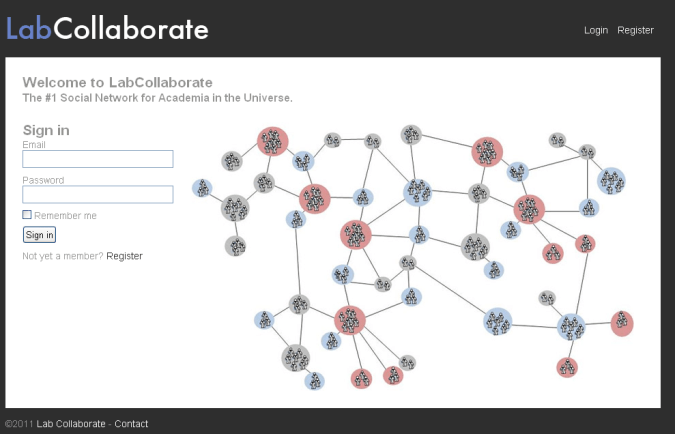
This morning UCSF’s McCormick lab announced the launch of LabCollaborate, a new website with the goal to “provide a way to easily share data, ideas and generally foster communication between labs as well as provide some useful tools for running the lab.”

I signed up to learn more about how it works. Here is what I have learned so far:

1. Lab Home Page: This is the page you see when you sign in. All the lab members profiles appear across the top, and you can see individual contact info and research interests (as well as update your own) by clicking on the pictures. As the first person to sign up the lab, you are an “admin”. Admins can add/remove lab members, edit library files and approve/delete friendships with other labs. You can extend these powers to any other user by clicking “Make admin” on their profile. If you want to.

2. Whiteboard: Here you can post comments or questions- they will be seen by your lab as well as your lab friends, but not by labs you are not friends with.

3. Friends: These are labs you want to keep in touch with and share data with. They can see and download all protocols, presentations and papers in your Library (unless marked “visible to my lab only”) as well as write on your whiteboard. A newsfeed to keep updated with what they’re doing is coming soon.

4. Libraries: These are collections of papers, presentations and protocols. Files can be tagged with keywords to organize into projects, ideas, lab members, whatever. And they are searchable! So you can group any number of protocols, literature references and presentations by whatever tag(s) you choose and find them all later with a simple search.

5. Ordering: The ordering system records vendor, quantity, and description as well as providing a direct link to the product page. It is also searchable to easily find past orders. Admins can mark orders as placed and the time of initial reqest and placement is recorded.

6. Find collaborators: The search box at the top of the page searches for words in the research interests of all labs and lab members on the network. So if you want to find other labs interested in “cancer”, just search and connect with new friends.

I am wondering whether – at some point – we can leverage the information LabCollaborate provides to enrich UCSF Profiles, and how on other hand LabCollaborate  can benefit from the UCSF Profiles data (tools).

I guess our tech team is aware of this. Looking forward to getting your thoughts, guys.

Using Research Networking Effectively in Academia: UCSF-CTSI Team Presents On National AMIA Panel

Three of us from the Virtual Home team at CTSI went to this year’s AMIA (American Medical Informatics Assoc) meeting in DC and presented on a panel with Griffin Weber of Harvard University. The panel was called “Four Steps to Using Research Networking Effectively at Your Institution”

Griffin spoke on cutting edge features of research networking tools, such as linked open data and social network analysis.

Eric Meeks of UCSF spoke on standard APIs, such as OpenSocial, to leverage a community of developers, I spoke about incentivize usage and understand your audience, and to round it out, Brian Turner spoke about using data, tools and strangers to improve user interfaces.

The panel presentation was a 90 minute break out session and we were happy to have a good turnout and an engaged audience. I think that the work that UCSF has put into the ‘social engineering’ of the tool has really paid off. Our usage and engagement numbers are on the rise and comparatively speaking, Griffin mentioned that our traffic is about 5-times that of what Harvard Profiles is currently getting.

In addition, Eric also had a poster session at the meeting!

The UCSF presentations will be up on Slideshare, available on the CTSI channel and via our individual UCSF profiles:

http://profiles.ucsf.edu/ProfileDetails.aspx?From=SE&Person=5333232
http://profiles.ucsf.edu/ProfileDetails.aspx?From=SE&Person=4621800
http://profiles.ucsf.edu/ProfileDetails.aspx?From=SE&Person=5333232

Notes from the 2011 Medicine 2.0 Summit at Stanford

Some argue that as technology advances it turns into a barrier and prevents essential human interactions, such as at the bedside. Even though this is a concern that we need to address, the Medicine 2.0 Summit 2011 provided a lot of examples that showed how technology can turn into a powerful mediator.

For those interested who did not get the chance to attend the event, here is a list of the main topics and initiatives presented that use social media, mobile computing applications, as well as Web 2.0 in healthcare and medicine to create new ways for people to connect. Please feel free to add your impressions and ideas of the summit and conference. Thanks!

1. If you are interested in learning from ePatients on how to build and leverage communities of practice and participatory medicine, you might want to explore the following blogs and platforms: 

  • Amy Tenderich’s blog Diabetesmine.com,
  • SmartMobs, authored by Howard Reingold, who was diagnosed with colon cancer and shared his experience on a blog called Howard’s Butt
  • PatientsLikeMe, where more than 115,000 members with over 1,000 conditions share their experiences to see what interventions are working for others

2. Patients have been connecting for some time. However, how can we help connect physicians and patients in a meaningful way? During the session “The Healthcare Transformers”, the panelists presented their views on personalizing healthcare and new ways for physicians and patients to communicate. 

  • Jay Parkinson, founder of HelloHealth and Futurewell, shared his passion about using creative design to improve health — and a few critical lessons learned (including” innovation is lonely” and “colleagues are critics”) as he and colleagues opened a “virtual clinic”, a “web-based patient communication, practice management and electronic health record in one solution”.
  • Lee Aase from the Mayo Clinic Center for Social Media gave a very entertaining talk on social media in the spirit of “Suus non ut Difficile” (It’s not that hard).  See one of their latest success stories: “When Patients Band Together – Using Social Networks To Spur Research for Rare Diseases”. They are very proactive about arming their health care professionals with the right tools to leverage social media for their successful communication. They even started a “Social Media Residency”. Aase also introduced the Social Media University, Global (SMUG), a post-secondary educational institution dedicated to providing practical, hands-on training in social media to lifelong learners.
  • Bryan Vartabedian, pediatric gastroenterologist, writes an interesting blog 33charts  about “the convergence of social media and medicine”.
  • Wendy Sue Swanson, practicing pediatrician, mother, and author of SeattleMamaDoc, walks a fine line and shares resources and methods that she learns from her patients, friends and family, both in and out of the field of medicine. She applies the concept of storytelling to achieve her goal of helping parents decipher some of the current medical news.
  • Ron Gutman, founder and CEO of HealthTap , who we wrote about in our earlier post, presented his solution to ending health care communication in silos. Some of the latest updates include 1) peer review features which will help give great questions more weight in the HealthTap environment, 2) offering a mobile solution, and 3) allowing participating doctors to be notified of questions coming from local patients.

3. “The Knowledge Revolution”: If you are interested in using innovations in Medical Education, you might find the following projects of interest:

  • Bertalan Mesko from Webicina.com provides curated medical social media resources in over 80 medical topics in over 17 languages to help patients and medical professionals access the most relevant social media content in their own languages on a customizable, easy-to-use platform for free.
  • Parvati Dev from Clinispace presented their virtual, 3D virtual training environment for healthcare professionals where learners can practice on realistic virtual medical scenarios and recover safely from errors.

4. The panel on  “The Interconnected Life” discussed social tools and platforms such as Epocrates, Google Correlate, which finds search patterns which correspond with real-world trends, and Quora.

5. During the panel “The New Scientist”, Michael Conlon presented VIVO , an “open source semantic web application”, a tool that is – like Profiles, Loci and others –  used or being implemented by universities across the nation to enable and support scientific collaborations and expertise discovery. 

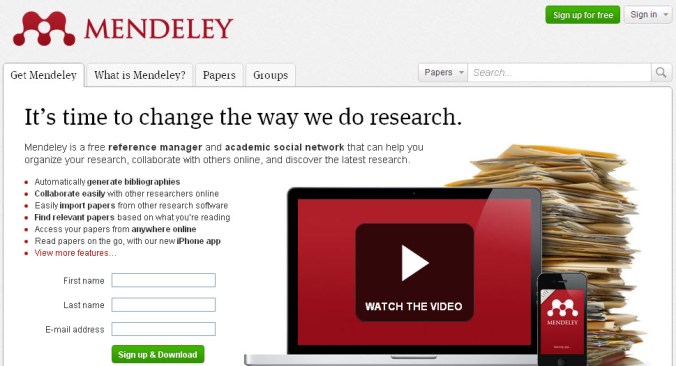
  • Jan Reichelt, Co-Founder and President at Mendeley, talked about how the tool, a free reference manager and academic social network, helps investigators organize their research, collaborate with others online, and discover the latest research.
  • Peter Bienfield from PlosOne reminded us that most of the 1.5 Million papers published every year are still “closed access”. However, as established publishers experiment with “open access”, e.g.,  Sage Open , BMJ Open , Biology Open ,and Scientific Reports ,  they validate the model…
  • And, David Pescovitz explained how he is looking for “signals” to identify far-out ideas. He is editor for Boing Boing and MAKE as well as research director with the Institute for the Future.

6. Dennis Boyle, IDEO Founding Member and Partner, gave an interesting closing keynote on “design thinking” and “a human-centered approach to innovation.” He highlighted some of their recent projects… worth exploring….

 More information:

Notes from the Digital Health Symposium: Interactions, Games, and Incentives in Healthcare

Can we gamify healthcare? There are interesting ideas out there. Here are a few that were presented during the event.

Ron Gutman, Founder & CEO of healthTap, presented the main idea behind healthTap: “trustsourcing”. When it comes to the consumption of health-related information online, physicians are the missing piece, he said. healthTap offers a new way for physicians to engage online – with their patients and with each other. They can answer questions to better serve existing patients and attract new ones, and they can virtually “agree” with what colleagues wrote which will automatically “feed” into their own “virtual practice”. I consider the “agree” button the professional networking aspect of the tool. Patients and people looking for health-related information can access the trusted (evidence-based) information 24/7, from anywhere.
I’d be curious to learn how they are going to assess the impact of the tool, e.g. saving time and money, which in the long run will serve as key motivators for physicians in addition to getting recognition and  building reputation. Keep reading

Sutha Kamal, Co-Founder and the CEO of Massive Health, talked about leveraging feedback loops, visualizing data to change behavior, and the importance of nuanced goals. They’ll be rolling out early versions of their products over the next couple of months and are looking for feedback. Sign up for one of their first experiments at http://www.massivehealth.com/experiment

Edwin Miller, VP Product Management at Practice Fusion, presented their free solution to transform the Electronic Health Record (EHR) System. According to Miller, 90% of doctors are still using paper charts.

Lindsay Volkmann, Director of Business Development at Keas, talked about how they are harnessing the power of play to encourage employees to get healthy.

Keas has combined gamification techniques with wellness incentives in an effort to get officemates battling one another to get healthier.
For about a year now, they have tested their social game. An average of 40% of the employees sign up and 70% of them stick with the program which resulted in significant behavior changes. Keep reading 

Ida Sim, MD, PhD, Professor of Medicine and Co-Director of CTSI’s Biomedical Informatics at UCSF, added another important question to the mix: How can we create a “learning healthcare system”, described in “Open mHealth Architecture: An Engine for Health Care Innovation”, that allows an integrated user experience, analysis  and evaluation services, and secure data sharing. View Ida’s presentation
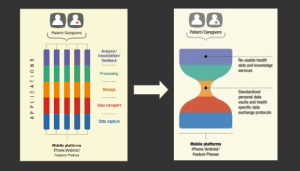
“A Learning Healthcare System that is designed to generate and apply the best evidence for the collaborative health care choices of each patient, and provider; to drive the process of discovery as a natural outgrowth of patient care.” – U.S. Institute of Medicine, Roundtable Charter

More information:

The event was co-sponsored by UCSF’s CTSI.

Is outsourcing experiments “the future of research”?

Palo Alto-based Science Exchange, which bills itself as “an online marketplace for science experiments”, thinks so.

According to their website: “Our goal is to make it easier for researchers to access core resources across institutions. Our first product, ScienceExchange.com brings together research scientists looking to outsource experiments with other scientists at core facilities of major research universities who have the capacity to conduct the experiments. By dealing with all the paying/billing administration, quality assurance and dispute resolution, ScienceExchange.com makes outsourcing experiments easy.”

Algorithms for diagnosis

According to O’Reilly Radar, Predictive Medical Systems is touting algorithms it has developed which can reportedly predict cardiac arrest and respiratory failure in an ICU setting, based on analysis of electronic medical record data. They’re currently running a validation trial, and working towards a formal FDA trial.

Read more:

The “first follower” is as important as the leader

 I was forwarded a great video from Opinder Bawa (UCSF’s CTO) today —  here’s the video and Opinder’s lead in. 

Kevin Grumbach mentioned in conversation the wonderful 5 minute video from a Ted talk about how being a “first follower” is as important as being a leader.

 Do check out the link below and I think you will find it as relevant as I did for what we are trying to do with team research, community engagement, health professional education, health care teamwork and the like.