Let’s play: An Expertise-Tagging Game

Researcher Jun Zhang and colleagues designed a social game to engage people in contributing to expertise profiling for themselves and their colleagues. In „Expertise­Tagging Game: Identifying Expertise Networks in organizations“ (2007) they describe how it works and a pilot study. Playing the game a user gets certain points when his or her input matches with other users’ input.

Thinking about our newly launched expertise finder system UCSF Profiles, a ‘game’ approach might be an interesting idea to explore. UCSF Profiles builds on a good set of data retrieved from Pubmed and already allows passive networks based on that information. However, active networking mechanisms will be helpful to retrieve ‘local knowledge’ that goes beyond scientific publications.

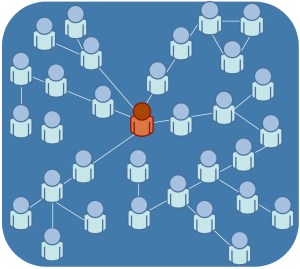
Here is how the game works: “A person’s expertise tags are presented in a masked tag cloud when the game starts. A user starts playing this game by typing a keyword in the text field following ‘John is a good person to talk to about (X) ‘ once a time. If a tag he sent matches a tag input by that individual or by other users who have played the game, the matched tag is revealed and the user earns some points based on how many other people have also tagged the same keyword.  The goal is to reveal all the masked words in the tag cloud. Top players are named as ‘top connectors’ in the landing page of the game site. Top players for a specific game are also listed in that game’s page as ‘who knows person (X) best’. A network visual-exploration interface  helps people discover the expertise networks around them.” The pilot study showed “that a lot of users were motivated by different fun factors, such as enjoyment of problem solving (revealing the tag cloud) and competition (being a top connector).”
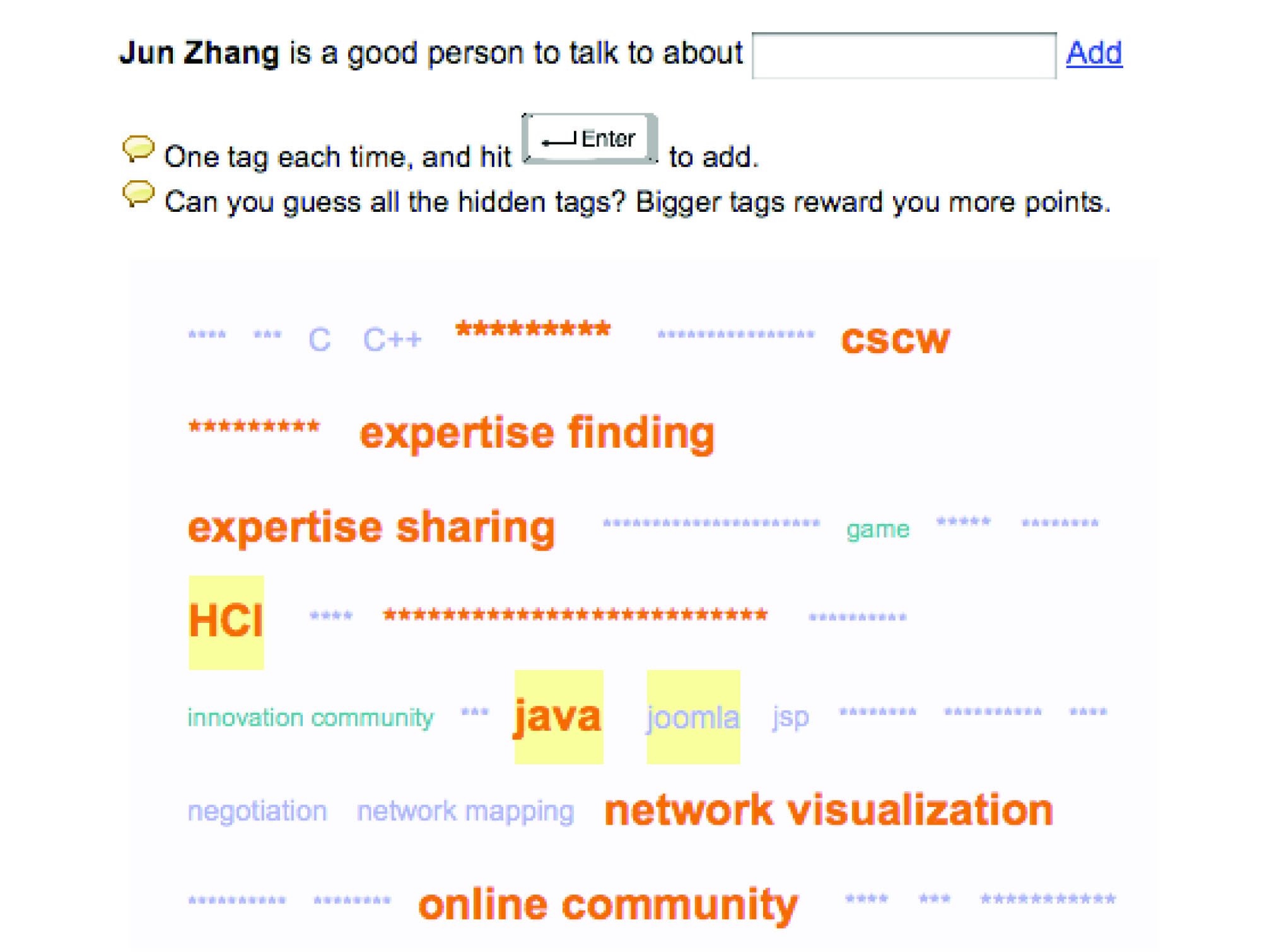
By the way, some senior users expressed concerns of deploying a game into a corporate environment, so the authors  repositioned the ‘game’ as a “system for people to recognize their colleagues by recommending their expertise using tagging as well a means of self-expression by self-tagging and approving peers’ tags”.

And while we are at it, here is a second one: “The Dogear Game” (2007).  Individual players receive entertainment and learn about their colleagues’ bookmarks. The player’s colleagues, on the other hand, receive recommendations of websites and documents of potential interest to them. The numbers are impressive: The game was implemented as a plug-in to a corporate instant messaging client used by over 100,000 employees. Read on.
A Tool to See How Others View our Website

Last month we launched our new home page. We pondered about what content should be above the fold, and how the new design will play out using different browsers. At that time, I did not know about the new tool Browser Size launched by Googlelabs. Browser Size makes it possible to test how others view our page, taking in account different sizes of monitors, browsers that are not always full screen and toolbars. It looks like a helful tool to save time during testing across browsers.

Here is how it works according to the creators: “Special code collects data on the height and width of the browser for a sample of users. For a given point in the browser, the tool will tell you what percentage of users can see it. For example, if an important button is in the 80% region it means that 20% of users have to scroll in order to see it.”

Keep reading at Introducing Google Browser Size

A Tool to Turn Networks into Backers

Today I learned about KickStarter, a funding platform for inventors and explorers, including artists, filmmakers, and journalist. It reminded me of  the Web site SciFlies where researchers can reach out to the public and promote project ideas to raise funding for testing initial ideas. We recently wrote about it in Integrating “grassroot” funding opportunities with research networking.

The key idea of KickStarter is different, though. It is a tool for mobilizing the existing networks of the project creator pic blog.pptto generate support. Site users can explore projects by various categories, view information about the pledged score, about how much is already funded, and when the ‘pledge drive’ will end.

Project creators keep the full ownership and control. People who pledge receive access to all project updates, which the project creator posts on the project blog. He decides which of the posts are publicly viewable and which exclusive to the backers. In addition, backers can ask the project creator questions via the “Send Message” button on any project page. Funding is all or nothing. Money is collected only if a project reaches or exceeds its funding goal before time expires.

I’m wondering whether such a tool could be helpful to researchers who want to raise small funding. But even more, it intrigues me whether it could help them find collaborators. Finding collaborators can go both ways: it may involve looking for a researcher in a specific discipline, but it could also be part of a ‘project market place’ where researchers post projects for which they need a collaborator.

Tangential Thoughts: A Speed-Networking Model Event for Scientists

At our retreat in July this year, I listened to conversations about the challenge of bringing researchers with questions to those with new information and techniques. Using technology is one way to help scientists step outside their usual research network and find expertise. But since face to face still matters, some wondered how an event that gives researchers the chance to meet a lot of people within a short time could look like.

The Weill Cornell Medical College Clinical and Translational Science Center has tried something new in the field of “speed-networking”. In a “Translational Research Bazaar” the Center used a “format popularized by speed dating” – so I learned reading an article featured on the Clinical & Translational Science Network. We wrote about this new network site in our post “New Clinical and Translational Science Network”.

And this is how it works: The organizers “reserved a room that could accommodate 100 people. The tables were SpeedNetBell_160[1]set up to minimize noise, maximize easy movement around the tables, and facilitate conversation”. Basic scientists and clinical & translational researchers “sit on opposite sides of a table and chat for 3 minutes until a bell rings, signaling that it’s time to move on and strike up a new conversation. This process continues until everyone in one group has met everyone in the other group”. As a result, “eighty-five percent of the participants said they met at least one potential collaborator”.

Interestingly, even those who were not looking for collaborators could benefit. For example, Even Robert Dottin, director of the Center for Study of Gene Structure and Function at Hunter College, suggested potential collaborators from within his center.

The first Translational Research Bazaar took place in October 2008. Since then the organizers have tracked the number of “new partners” who submitted grant proposals over the course of 2009 through follow-up surveys and phone calls. And what have they learned and will do differently next time?

  • Require that registrants complete an online bio with photo, contact information, their research priorities and needs before the event.
  • Be prepared to be flexible: “More than 80 people signed up” for the event that was free of charge; “one-third of the registrants didn’t show up”. But “many new people appeared on the day of the event to register onsite”.
  • Use a cowbell instead of a microphone to be sure the signal to switch partners will be heard “over the din”.
  • Color-codeddance cards’ are useful which were to match the side of the table people sat on. The cards “listed the names and top research interests of each registrant, with a blank line to scribble a quick note”.
  • Provide bottles of water, as people will spend about 2 hours talking almost nonstop.
  • Keep the speed networking to an hour as people get exhausted
  • The “wine-and-cheese hour that followed turned out to be a critical, because “people had ideas they were anxious to discuss.”
  • Send a follow-up email with a link to the bios registrants completed.

Also interesting:

Internet Summit 2009 – Opportunities and Trends created by Web Innovation

4 – 5 November 2009, Raleigh, North Carolina

The event will “showcase and promote forward thinking and thought leadership on topics related to the Internet economy and web oriented technologies”. The agenda includes: social media, online advertising strategies, blogging, Twitter & Real Time, search, video, email marketing, cloud, analytics, design and usability. View all agenda topics.

SpeakersMore information

Researchers test ‘Google Wave’

Recently we mentioned ‘Google Wave’ in the post “Google Wave: Next generation communication & collaboration tool” which is expected to be released later this year. Even though it is not designed for the specific needs of science, some researchers are testing how it might serve their work purposes. Biochemist Cameron Neylon from the University of Southampton, UK, was among the few who could access Google Wave prior to its release. In a recent interview with Nature, Neylon makes clear that Google Wave is still a complicated application. Nonetheless, according to him there are some plausible benefits that could help transform the way researchers communicate, document their results and collaborate on manuscript preparation.

goolewave[1]

As a summary, Google Wave could be “used for collaborative authoring, to speed up writing papers and grant applications”. It’s also possible to “create automatic programs that buzz around the document, annotating it in ways that are hidden from the human reader. The automated programs, or ‘robots’, make it possible to link to related scientific documents; mark up text so that, for example, protein names are automatically linked to a protein database”. Researchers can “pull in data from elsewhere and create live graphs that update as the data change”. As a result, scientific manuscripts would no longer be “static”, but could be “converted to the format of a published paper, updated over time and retain all that annotation”.     

In addition, Neylon mentions “scientists could share their experimental processes in a way that’s hard to do at the moment. For example, as data come off a laboratory instrument via a computer, a program could insert them straight into the document” and “another program could visualize those data”. Researchers could “control, monitor and observe an experiment” and “share that wave with someone else as a template for their experiment”.


Tangential Thoughts: The “Science of Connections”

325_425_f21

For those of you who like to delve into the research of networks a couple of articles, which were recently published in Science, might be interesting.

As I learned, scientists still “tend to describe how a complex system looks and behaves”, because it’s not clear what a complex system is exactly. So far researchers define it as something that “consists of many elements that interact so strongly that they tend to organize themselves in one way or another”.  As a comparison: “A car may be complicated, but it is not a complex system, as each of its parts interacts with a few others in a predictable way. But cars in traffic form a complex system, as drivers’ jockeying for position can lead to surprises such as ‘phantom’ traffic jams that arise for no obvious reason”.

Some of the articles:

Reading “Predicting the Behavior of Techno-Social Systems” I learned about what brings us closer to achieving true predictive power of the behavior of techno-social systems and that there is the need for a “network” mindset. The article focuses on human interactions and mobility and talks about moving the analysis of networks from “small social groups” to the “quantitative analysis of social aggregate states”.

Scale-Free Networks: A Decade and Beyond” talks about whether real networks as the society, the Internet, or the cell could function seamlessly if their people, nodes, or molecules, were wired randomly together.

Revisiting the Foundations of Network Analysis” explores when a node is a node, standard frameworks, network processes and the choice of the right network presentation. Some of the key words for me: “reality mining”, which has been defined as the “collection of machine-sensed environmental data that are related to human social behavior”.


Science-Based Approach to Online Participation

Researchers may disagree on the best social media or “crowdsourcing” approach. However, existing online communities that explore new social participation ideas provide a “vast laboratory” for testing theories about technology-mediated social interaction. Wikipedia, Twitter, Patients Like Me, Open Innovation Pavillion, Watch Jefferson County and Innocentive – today a great amount of data is becoming available, as stated in the recent article “Computational Social Science”. Now is the time to use these data and perform experiments at massive scale, wrote a team of researchers led by Ben Shneiderman, professor for computer science at the University of Maryland. They authored a white paper called “National Initiative for Social Participation” which suggests a “scientific foundation for thinking about technology-mediated social interaction”.

A core assumption is that there are “better and worse forms of social participation and social connectedness”. But what makes them better or worse? We have been thinking about this for a while, as we work towards the launch of UCSF’s research networking site mentioned in the recent post OpenSocial & Best Practices for Social Networking Websites.  Ben Shneiderman’s team argues that an organized research program could help to accelerate promising social action networks and answer fundamental questions about functionality, usability and sociability. For example: What motivates participants to come to a site, read, contribute and collaborate? What are best practices for moderation facilities? How do successful online communities handle the start-up paradox, recruit and socialize newcomers, encourage commitment and contribution from members? And how important are cooperation, competition, and trust for an individual’s participation? Not to mention legitimate dangers;  the white paper states to the point: “In the social networking ideal universe, anyone can connect with anyone else. In the ideal secure universe, there is insurance against that.”

Finding answers to these questions would offer the chance to “redesign and repurpose” social media technologies, improving “usability and sociability to better engage people with diverse motivations, experiences, perspectives, skills and knowledge”. Ben Shneiderman’s team envisions using the knowledge to “produce profound transformations in healthcare, community safety, disaster response, life-long learning, business innovation, energy sustainability, environmental protection, and other important national priorities.”

In this spirit, the National Science Foundation announced a $15-million Social-Computational Systems grant program to support research around social networking – a good opportunity to establish a stronger basis for evidence-driven discussions about online participation.

Is Distance Dead?

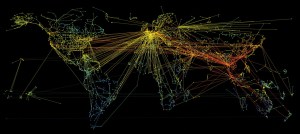
Is the Internet changing our world into a “borderless society” or are geographical distances still relevant when it comes to social interactions? Jacob Goldenberg and Moshe Levy at Hebrew University analyzed Facebook users and the location of email messages to find out more. In their article “Distance Is Not Dead: Social Interaction and Geographical Distance in the Internet Era” the researchers raise doubts about the “Global-Village-Theory”. They come to the conclusion that the importance of physical proximity in social interactions is a “stronger force” than ever. It seems people prefer to send messages over shorter distances – they mostly connect online with those they know off-line.

For more details view the original article or the blog post on the subject in Technology Review, which also talks about “why we have gone so wrong in thinking that the world is getting smaller”, the “six-degrees-of-separation experiments originally performed by Stanley Milgram with letters and later by Steve Strogatz and Duncan Watts using e-mail”.