Notes from the 2011 Medicine 2.0 Summit at Stanford

Some argue that as technology advances it turns into a barrier and prevents essential human interactions, such as at the bedside. Even though this is a concern that we need to address, the Medicine 2.0 Summit 2011 provided a lot of examples that showed how technology can turn into a powerful mediator.

For those interested who did not get the chance to attend the event, here is a list of the main topics and initiatives presented that use social media, mobile computing applications, as well as Web 2.0 in healthcare and medicine to create new ways for people to connect. Please feel free to add your impressions and ideas of the summit and conference. Thanks!

1. If you are interested in learning from ePatients on how to build and leverage communities of practice and participatory medicine, you might want to explore the following blogs and platforms: 

  • Amy Tenderich’s blog Diabetesmine.com,
  • SmartMobs, authored by Howard Reingold, who was diagnosed with colon cancer and shared his experience on a blog called Howard’s Butt
  • PatientsLikeMe, where more than 115,000 members with over 1,000 conditions share their experiences to see what interventions are working for others

2. Patients have been connecting for some time. However, how can we help connect physicians and patients in a meaningful way? During the session “The Healthcare Transformers”, the panelists presented their views on personalizing healthcare and new ways for physicians and patients to communicate. 

  • Jay Parkinson, founder of HelloHealth and Futurewell, shared his passion about using creative design to improve health — and a few critical lessons learned (including” innovation is lonely” and “colleagues are critics”) as he and colleagues opened a “virtual clinic”, a “web-based patient communication, practice management and electronic health record in one solution”.
  • Lee Aase from the Mayo Clinic Center for Social Media gave a very entertaining talk on social media in the spirit of “Suus non ut Difficile” (It’s not that hard).  See one of their latest success stories: “When Patients Band Together – Using Social Networks To Spur Research for Rare Diseases”. They are very proactive about arming their health care professionals with the right tools to leverage social media for their successful communication. They even started a “Social Media Residency”. Aase also introduced the Social Media University, Global (SMUG), a post-secondary educational institution dedicated to providing practical, hands-on training in social media to lifelong learners.
  • Bryan Vartabedian, pediatric gastroenterologist, writes an interesting blog 33charts  about “the convergence of social media and medicine”.
  • Wendy Sue Swanson, practicing pediatrician, mother, and author of SeattleMamaDoc, walks a fine line and shares resources and methods that she learns from her patients, friends and family, both in and out of the field of medicine. She applies the concept of storytelling to achieve her goal of helping parents decipher some of the current medical news.
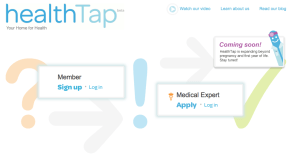
  • Ron Gutman, founder and CEO of HealthTap , who we wrote about in our earlier post, presented his solution to ending health care communication in silos. Some of the latest updates include 1) peer review features which will help give great questions more weight in the HealthTap environment, 2) offering a mobile solution, and 3) allowing participating doctors to be notified of questions coming from local patients.

3. “The Knowledge Revolution”: If you are interested in using innovations in Medical Education, you might find the following projects of interest:

  • Bertalan Mesko from Webicina.com provides curated medical social media resources in over 80 medical topics in over 17 languages to help patients and medical professionals access the most relevant social media content in their own languages on a customizable, easy-to-use platform for free.
  • Parvati Dev from Clinispace presented their virtual, 3D virtual training environment for healthcare professionals where learners can practice on realistic virtual medical scenarios and recover safely from errors.

4. The panel on  “The Interconnected Life” discussed social tools and platforms such as Epocrates, Google Correlate, which finds search patterns which correspond with real-world trends, and Quora.

5. During the panel “The New Scientist”, Michael Conlon presented VIVO , an “open source semantic web application”, a tool that is – like Profiles, Loci and others –  used or being implemented by universities across the nation to enable and support scientific collaborations and expertise discovery. 
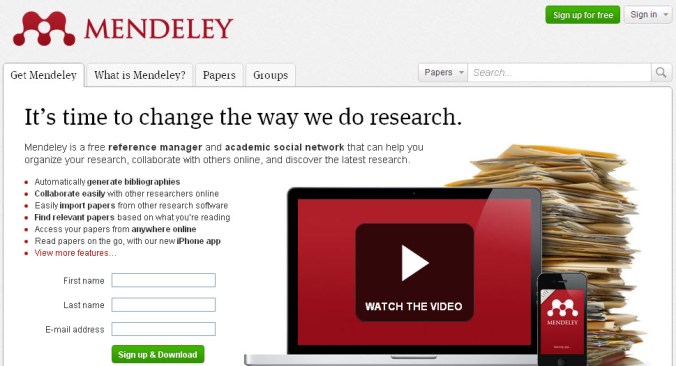
  • Jan Reichelt, Co-Founder and President at Mendeley, talked about how the tool, a free reference manager and academic social network, helps investigators organize their research, collaborate with others online, and discover the latest research.
  • Peter Bienfield from PlosOne reminded us that most of the 1.5 Million papers published every year are still “closed access”. However, as established publishers experiment with “open access”, e.g.,  Sage Open , BMJ Open , Biology Open ,and Scientific Reports ,  they validate the model…
  • And, David Pescovitz explained how he is looking for “signals” to identify far-out ideas. He is editor for Boing Boing and MAKE as well as research director with the Institute for the Future.

6. Dennis Boyle, IDEO Founding Member and Partner, gave an interesting closing keynote on “design thinking” and “a human-centered approach to innovation.” He highlighted some of their recent projects… worth exploring….

 More information:

Notes from the Digital Health Symposium: Interactions, Games, and Incentives in Healthcare

Can we gamify healthcare? There are interesting ideas out there. Here are a few that were presented during the event.

Ron Gutman, Founder & CEO of healthTap, presented the main idea behind healthTap: “trustsourcing”. When it comes to the consumption of health-related information online, physicians are the missing piece, he said. healthTap offers a new way for physicians to engage online – with their patients and with each other. They can answer questions to better serve existing patients and attract new ones, and they can virtually “agree” with what colleagues wrote which will automatically “feed” into their own “virtual practice”. I consider the “agree” button the professional networking aspect of the tool. Patients and people looking for health-related information can access the trusted (evidence-based) information 24/7, from anywhere.

I’d be curious to learn how they are going to assess the impact of the tool, e.g. saving time and money, which in the long run will serve as key motivators for physicians in addition to getting recognition and  building reputation. Keep reading

Sutha Kamal, Co-Founder and the CEO of Massive Health, talked about leveraging feedback loops, visualizing data to change behavior, and the importance of nuanced goals. They’ll be rolling out early versions of their products over the next couple of months and are looking for feedback. Sign up for one of their first experiments at http://www.massivehealth.com/experiment

Edwin Miller, VP Product Management at Practice Fusion, presented their free solution to transform the Electronic Health Record (EHR) System. According to Miller, 90% of doctors are still using paper charts.

Lindsay Volkmann, Director of Business Development at Keas, talked about how they are harnessing the power of play to encourage employees to get healthy.

Keas has combined gamification techniques with wellness incentives in an effort to get officemates battling one another to get healthier.

For about a year now, they have tested their social game. An average of 40% of the employees sign up and 70% of them stick with the program which resulted in significant behavior changes. Keep reading 

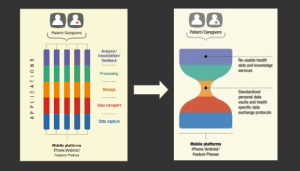
Ida Sim, MD, PhD, Professor of Medicine and Co-Director of CTSI’s Biomedical Informatics at UCSF, added another important question to the mix: How can we create a “learning healthcare system”, described in “Open mHealth Architecture: An Engine for Health Care Innovation”, that allows an integrated user experience, analysis  and evaluation services, and secure data sharing. View Ida’s presentation

“A Learning Healthcare System that is designed to generate and apply the best evidence for the collaborative health care choices of each patient, and provider; to drive the process of discovery as a natural outgrowth of patient care.” – U.S. Institute of Medicine, Roundtable Charter

More information:

The event was co-sponsored by UCSF’s CTSI.

Take Advantage of Web-Based Tools to Present Complex Data

Research to Action published a great overview article that highlights an “ever-growing open-data source for development statistics in the fields of economics, healthcare, education, social science, technology,” and more.

Including data and statistics within research findings can enhance their impact, however, large tables or spreadsheets of numbers take time to decipher and sometimes the true meaning behind the data itself can be misinterpreted.

Here are some of the tools that the article points out:

  • StatPlanet: browser-based interactive data visualization and mapping application to create a wide range of visualizations, from simple Flash maps to more advanced infogrpahics.
  • Xtimeline:  to create your own timelines of data.
  • Gap Minderto upload data and create an interactive motion charts and graphs.
  • Creately:  to use Online Diagramming software – purpose built for team collaboration.
  • Google Chart Tools: lets you include constantly changing research data sourced online. Google has also released Fusion Tables where you can share, discuss and track your charts and graphs with specific people online.
  • Tagcrowdto upload texts and highlight the most common concepts. The clouds can be exported as images and inserted in a website or power point presentation.
  • Wordle: similar to tagcloud; lets you create images out of key phrases and words relevant to your research, great for using in PowerPoint presentations.
  • Tableau: a free Windows-only software for creating colourful data visualisations.

View all and read the original article

Mayo Clinic Finds Social Media Valuable Tool to Recruit Study Participants for Rare Diseases

Recently, a researcher told me that he’d be interested in learning more about using social media and networking sites to recruit participants for research studies. Here is an example that the Mayo Clinic shared this week.

Through patient-run websites dedicated to heart conditions and women’s heart health, a team of cardiologists is reaching out to survivors of spontaneous coronary artery dissection, also known as SCAD, a poorly understood heart condition that affects just a few thousand Americans every year.

The study landed 18 participants in less than a week, six more than could participate in this pilot of 12 patients. The remaining volunteers are eligible to participate in a new, larger study based on the initial study’s success.

The new research seeks patients through conventional and social media outlets and aims to build a virtual registry and DNA biobank of up to 400 SCAD survivors and their relatives. The database will help physicians conduct more detailed analyses of treatment strategies and factors that affect prognosis and better understand the possible genetic basis of some SCAD cases.

“Patient leadership in this is huge,” says study co-author Lee Aase, director of Mayo Clinic’s Center for Social Media. “Designing research protocols to study rare diseases and then recruiting enough patients to participate is extremely difficult for busy physicians, but patients with rare diseases are highly motivated to see research happen.”

Keep reading

“Search Needs a Shake-Up: From Simple Document Retrieval to Question Answering”

If you are thinking about making Internet trawling more efficient, take a look at the recent perspective published in Nature. Researcher Oren Etzioni (whose lab introduced open information extraction) “calls on researchers to think outside the keyword box…”

Open information extraction obviates topic-specific collections of example sentences, and instead relies on its general model of how information is expressed in English sentences to cover the broad, and unanticipated, universe of topics on the Internet.

The basic idea is remarkably simple: most sentences contain highly reliable syntactic clues to their meaning. For example, relationships are often expressed through verbs (such as invented, married or elected) or verbs followed by prepositions (such as invented by, married to or elected in). It is often quite straightforward for a computer to locate the verbs in a sentence, identify entities related by the verb, and use these to create statements of fact. Of course this doesn’t always go perfectly. Such a system might infer, for example, that ‘Kentucky Fried Chicken’ means that the state of Kentucky fried some chicken. But massive bodies of text such as the corpus of web pages are highly redundant: many assertions are expressed multiple times in different ways. When a system extracts the same assertion many times from distinct, independently authored sentences, the chance that the inferred meaning is sound goes up exponentially.

Much more research has to be done to improve information-extraction systems — including our own. Their abilities need to be extended from being able to infer relations expressed by verbs to those expressed by nouns and adjectives. Information is often qualified by its source, intent and the context of previous sentences. The systems need to be able to detect those, and other, subtleties. Finally, automated methods have to be mapped to a broad set of languages, many of which pose their own idiosyncratic challenges.

One exceptional system — IBM’s Watson — utilizes a combination of information extracted from a corpus of text equivalent to more than 1 million books combined with databases of facts and massive computational power. Watson won a televised game of Jeopardy against two world-class human players in February this year. The multi-billion dollar question that IBM is now investigating is ‘can Watson be generalized beyond the game of Jeopardy?’

“Using Prizes to Spur Open Innovation”: The National Institutes of Health (NIH) Explore Potential Approaches

This week’s NIH conference “Crowdsourcing: The Art and Science of Open Innovation” could be a hint that the research agency is seriously considering new ways to take advantage of the “processing power of lots of willing brains”.

ScienceInsider published a summary report that states:

NIH Director Francis Collins would soon sign papers that would ensure NIH is compliant with the America COMPETES Act, which gives federal agencies the authority to offer cash incentives for researchers to tackle high-risk, high-reward research questions that have eluded more traditional funding platforms, such as grants and sponsored research.

The America COMPETES Act was first passed in 2007 and was reauthorized in December. Under its authority, federal agencies outline a problem they’d like solved on Challenge.gov, then open the competition to individuals or teams, evaluate the results, and award a money prize to whoever turns in the best solution.


LabLife.org – A Model for a Future Research Portal at CTSI, and perhaps even UCSF?

This site is interesting because it helps researchers perform a variety of tasks and supports their online community. At the same time, it provides clear paths to access more information without overwhelming the user. And btw, the goal of the site is easily comprehensible.

LabLife is free for academic labs. We recently learned that UCSF postdocs are using it frequently. And they’re not the only ones, according to LabLife over 1800 labs from 1200 institutions world-wide are using the site.

Here are a few examples how the site supports several aspects of a researcher’s lab life:

  • searching for products,
  • coordinating purchases (preventing ordering mistakes),
  • managing (tracking) reagents, documents, and data,
  • searching for jobs and publications, and
  • sharing information with colleagues and the community.

What do you think?

Pfizer Announces First U.S. “Virtual” Clinical Trial Allowing Patients to Participate Regardless Of Geography

The randomized pilot study, called REMOTE, uses mobile phone and web-based technology (e.g. electronic diaries, online testing tools, a dedicated website) to collect the necessary data for the trial without clinic visits.

Investigators plan to enroll about 600 patients from about 10 states across the United States. Pfizer will compare results to previous clinical trials and assess whether virtual trials can save time and obtain the same results as traditional ones, or perhaps even more reliable data through increased patient compliance, lower withdrawal rates and real-time data collection.

Although not all clinical trials could be done remotely, if this pilot proves successful, it might be an interesting model for our emerging UCSF-CTSI Participant Recruitment Service.

Watch the animated video that outlines the trial’s basics to patients

More information: